
He is a middle school principal who loves working with students, bringing out the best in them every single day. But there is a secret talent that keeps Bryan Leggat going long after the last bell of the day at Elk Ridge Middle.
On this episode of the Supercast, we find out about Mr. Leggat’s longtime passion for painting and creating beautiful works of art. Hear how he finds inspiration as an artist, sometimes thanks to his meaningful and impactful work as a school principal and the relationships he has built along the way.
Audio Transcription
Bryan Leggatt:
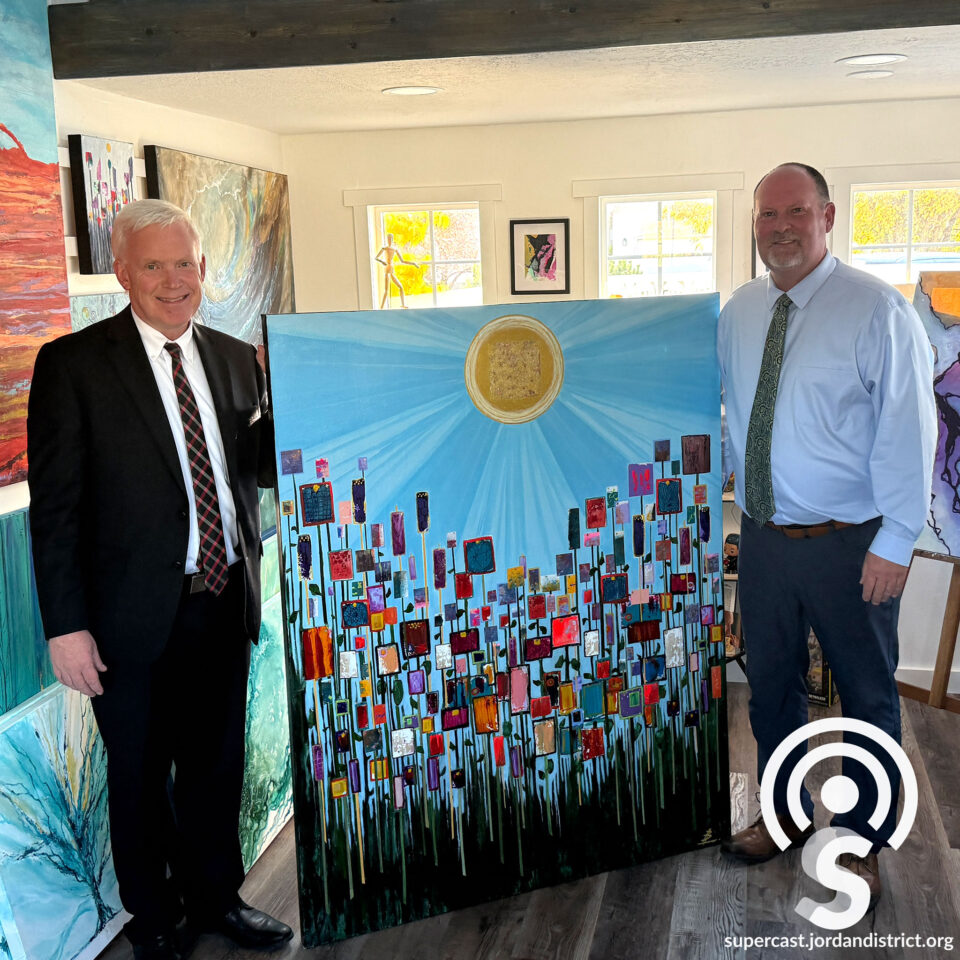
“The Maestro's Garden” represents the influence educators have, like a sun shining on a garden of thought of flowers, each one better because of that influence. I don't see oftentimes the results of what I'm doing with a student per se, but I can come here and I can paint something, I can stand back and say, "Oh wow, that's what I did today." So it is quite different.
Anthony Godfrey:
Hello and welcome to the Supercast. I'm your host, Superintendent Anthony Godfrey. He is a middle school principal who loves working with students, bringing out the best in them every single day. But there's a secret talent that helps keep Bryan Leggatt going long after the last bell of the day at Elkridge Middle School. On this episode of the Supercast, we find out about Mr. Leggatt's longtime passion for painting and creating beautiful works of art. Hear how he finds inspiration as an artist, sometimes thanks to his meaningful and impactful work as a school principal and the relationships he has built along the way.
Anthony Godfrey:
We're talking today with Bryan Leggett, who is principal at Elkridge Middle School, and an artist on top of that, and we are here at his home in his home studio. it's really exciting to be here, Bryan.
Bryan Leggatt:
Thank you. Welcome to my studio.
Anthony Godfrey:
First of all, tell us about the structure here. This is just right next to your home and a place for you to work and display your work.
Bryan Leggatt:
Yeah.
Anthony Godfrey:
Tell us about how long it's been here and the decision to do this.
Bryan Leggatt:
Well, I'll be honest, the studio used to be in my basement.
Anthony Godfrey:
Yeah.
Bryan Leggatt:
Used to be in a room in my basement until my daughter decided she wanted to move down into that room. And so we thought, okay, that might be a good time to find another location, maybe outside of the house. So this is just an outbuilding here outside of my home and a place that I could just kind of concentrate on my work, listen to good music, paint away, and have a good time. So that's what it was for. We started building this about a year and a half ago, and it took me about that amount of time. I just finished it recently within the past few months that I could start moving into it and kind of displaying my art and finding a bigger space in which I could work. It's come together, I think, pretty nice so far and we'll see where it goes from here.
Anthony Godfrey:
As a sanctuary, how does it compare to the basement?
Bryan Leggatt:
Oh, it's much nicer. I mean, it's much bigger.
Anthony Godfrey:
You really are separated from things. So you can really escape.
Bryan Leggatt:
I can really blast the music.
Anthony Godfrey:
Is this where people can find you when you're nowhere else to be found?
Bryan Leggatt:
Probably. Yeah.
Anthony Godfrey:
“Oh, yeah, he's out. He's out in the studio.” Well, it's gorgeous. I love the attic here that you've got, a little shelf to store your work. And before we get to your work, you have quite a few of the pop bobbleheads here.
Bryan Leggatt:
I tell you, you would be impressed.
Anthony Godfrey:
Is there a theme to this collection? Because I see a lot of recognizable figures.
Bryan Leggatt:
Yeah, I mean, I don't know if there's a theme. My biggest theme is my Star Wars theme over here. So I have lots of funko pops that are Star Wars.
Anthony Godfrey:
Oh, wow.
Bryan Leggatt:
I know you love Star Wars as well and I just picked them up over the years. Maybe this is why I do art. Is that I can sell my artwork and buy more funko pops. Who knows?
Anthony Godfrey:
What inspires you in art? Funko pops. That's really what gets me there.
Bryan Leggatt:
Everyone has their inspiration.
Anthony Godfrey:
Before we talk about the work itself, talk to me about the various materials that you like to use. I see acrylics there.
Bryan Leggatt:
Yeah, I usually just paint in acrylics. They're just a lot faster for me. They're safer. I don't have to deal with, you know, the types of things that might impact my sense of smell. I don't work with oils and so forth. Oh, so I just deal with water, you know, water and acrylic. It allows me to get my paintings done pretty quickly. That's always my goal when I start a painting is to get a lot of it done in one sitting or within a couple of days. Then I let it sit on a wall somewhere and I look at it for a while. And then I make I touch things up. I come back to it. Sometimes I'll even paint over it. I think one of the things I've learned is mistakes are what we do. That's how creative creativity takes place is you make mistakes, you take the risk. And yeah, and so some of these that you see in here, I've they've actually been painted over. And so it's just something that I do. I look at it for a while. And if I don't like it, I'll just paint over the top of it and find something else. But acrylics allow me to do that. And so I enjoy working with acrylics.
Anthony Godfrey:
When you said the acrylics are safer, what I thought you meant initially was not safer than oils that might be toxic, but safer than watercolor, meaning that you can cover over your mistakes where watercolor doesn't allow you to do that.
Bryan Leggatt:
Yeah, both, with some of the toxicity that goes in that's involved in oils.
Anthony Godfrey:
Yeah.
Bryan Leggatt:
So I'm just going to stay away from that and stick with something that's a little safer. And I can paint over the top, you know, with as you mentioned with watercolors, sometimes that's just once you put it down on paper, it's hard to adjust it.
Anthony Godfrey:
Do I see some watercolors up here, though?
Bryan Leggatt:
No, these are actually still acrylic here.
Anthony Godfrey:
Wow. That landscape there . . .
Bryan Leggatt:
Yeah. I do a lot of glazing, so some like coats of colors. So sometimes it appears to be a watercolor.
Anthony Godfrey:
Yeah. Yeah. I really like that series there. I'd like to talk about the recent show at Riverton City. Tell me about that.
Bryan Leggatt:
Well, yeah, that's the second time I was involved in that show. I submitted a few. So for those that don't know, Riverton, well, the school district puts on a show for educators that are typically artists, art teachers in the District, but can really be open to anyone that anyone that does art. And then they have found a really nice venue. It's the Old Dome in Riverton. So this was the second year that I had one of my pieces. I had a couple last year. I gave them one of my pieces to display this year. It's a piece that really meant a lot to me because it does... It's one that I have been making for a very important teacher in my life and my daughter's life. And that's Kelly Dahan. Many of you know Kelly Dahan.
Anthony Godfrey:
Kelly is an amazing teacher.
Bryan Leggatt:
He's one of the best. One of the best. A couple of years ago, well, for a few years, he helped my daughter get through some tough times at Mountain Ridge. And so I'm really happy for him. I'm just so grateful for what he did. I told him after she graduated, that I would create a piece for him. I even went over to his home. We looked at a spot. I don't know if that spot is still available because it's been a couple years. But he collects art also. I just wanted to add to his collection, so I put a piece together that actually... I'm gonna read you what I wrote. And it's called “The Maestro's Garden.” It's the one right over here.
Anthony Godfrey:
And this is from the plaque that was by the painting.
Bryan Leggatt:
By the painting. So those of you that saw the painting, you've probably read this. But it goes out to really all educators. This is called “The Maestro's Garden.” “The Maestro's Garden represents the influence educators have, like a sun shining on a garden of flowers, each one better because of that influence. The lessons, the examples, the love. The teacher's shining light can be felt for years and this piece represents the many lives each unique in their own ways that could not thrive without caring educators. We are also fortunate to have opportunities each day to influence the lives of our young people. Maestro's in our own beautiful gardens.” So that's what this is. It's a garden of a lot of different flowers. Each one is unique. Not one of them is the same as others. There's about a hundred of them. It just represents the sun shining down on them and their growth. One of the things that happens with educators is we often don't get to see, you know, the future of what happens with our students. Sometimes we'll run into them in the neighborhood or someplace, and then we get to learn about them. If they graduated or what they're doing for their job, what career they've decided to go into. So that's one thing I really enjoy about art is, you know, all day long I can be a principal and work with kids and I don't see oftentimes the results of what I'm doing with a student per se. But I can come here, and I can paint something. I can stand back and say, "Oh wow, that's what I did today."
Anthony Godfrey:
Right.
Bryan Leggatt:
So it is quite different.
Anthony Godfrey:
Which helps me understand also why you want to make sure that you're able to complete the art, at least the initial version of it, quickly. Because you don't always get that reward. I do tell people that, you know, friends who are general contractors and that we drive by and they can say, "I built that building." And I drive by and say, "Well, I wrote an email in that building. I held a meeting in that building. I made a phone call in that building." But you don't always feel the results of what you do. So this is a really nice tribute to the results of Kelly Dahan's impact in your life and your daughter's life.
Bryan Leggatt:
Yeah. Well, thank you.
Anthony Godfrey:
I love it. I've seen it. I think it's a beautiful work. And there's a little bit of an, I don't know that it's an abstract aspect to it, but all of the flowers are not necessarily representational. Describe this for those who haven't seen it or who can't see it.
Bryan Leggatt:
Well, I started doing this by painting, actually behind this. This is one of those that's painted over. So I started creating, my idea was this garden and the sun, you know, represent, you know, or help helping out each flower to grow and blossom to bloom. And I just didn't like it. It didn't really, I didn't connect with it. So I started, I just painted over it and I said, you know, I'm going to just stay away from a more realism look to it and go abstract. I think that, you know, you have a round sun, which is kind of like kind of that roundness of, you know, maybe what happens as you develop you, you know, from a square to a circle, not that squares are bad, but, you know, something to, to obtain in life. And all of these are squares or rectangles wanting to become something better, you know, whatever it might be. So there is a square inside that sun representing that teacher, but kind of that idea that even the teachers continuing to grow and develop. And so yeah, each of these, some of these flowers, actually what I did is I started creating just the squares for each flower. And I thought, you know, this has taken me a while so I started something, a new technique, and that is, I just got some unstretched canvas. I threw a lot of paint down on that unstretched canvas, and then I started finding areas that I really liked, and I cut those areas out, and those became other squares that I added to this. So I put canvas on canvas, which I've never done before and so it kind of created. Then I also went in and I masked areas off and I, and I use some, I use some light molding paste to kind of bring it up. So if you look at it from the side, you can kind of see that some are raised a little bit more than others and that's because I've used that light molding paste. I really enjoy using that stuff.
Anthony Godfrey:
Oh yeah. I can see that.
Bryan Leggatt:
Then I used, and also what you'll notice is there is a fleck of gold in each one of these flowers. Every single one of the flowers has a fleck of that gold or a little bit of that, you know, that influence from the teacher.
Anthony Godfrey:
Wow. Stay with us when we come back, more with Bryan Leggatt, the principal of Elkridge Middle School.
Male Voice:
Never miss an episode of The Supercast by liking and subscribing on your favorite podcasting platform. Find transcripts for this episode and others at supercast.jordandistrict.org.
Female Voice:
Does your child need the flexibility to learn from anywhere at any time, on a cruise in another country or simply at home, cozy on the couch? The Jordan Virtual Learning Academy is tailor-made for you and your family. It's personalized, dynamic virtual learning on your schedule. The Jordan Virtual Learning Academy is an integrated system of three schools in Jordan School District: Rocky Peak Virtual Elementary School, Kelsey Peak Virtual Middle School, and Kings Peak High School. Our programs are designed to meet or exceed district and state core curriculum standards, ensuring your child receives a superior educational experience tailored to their needs. Join us today at JordanVirtual.org.
Anthony Godfrey:
For those who don't know, you tell us, tell us, talk us through your career as an educator.
Bryan Leggatt:
Yeah, so I started back, I got off an LDS mission back in the early 90s. I went to Salt Lake Community College, started, I studied architecture, and I went into architecture because as a kid I loved drawing, I loved being artistic, I played with Legos. That idea of creating something unique was pretty special to me and important. So I started the architecture program there, and at the same time I was teaching English as a Second Language for the District. I was one of those tutors that would go around and help kids during the day. I also, some of you know Moncone Tugmala and Paul Pitts that used to work in the District, special people to me. I taught English as a Second Language at night time, so for the adults, mostly over at West, the old West Jordan Middle School building. So I would go and I would learn all day about architecture and had a fun time doing that, but then I went, but I loved going to work at night and helping these great people. I learned that I didn't really know a lot about construction, so I kind of moved away from architecture and that inspired me to go into teaching. So I got my first job, I opened up South Hills Middle School with Bob Sproul, and that was fun. We had half of our day was spent over, and you know the kids showed up at 12:30 in the afternoon to start school, and they ended at 6:30. We were over at Oquirrh Hills Middle School because South Hills hadn't been finished yet.
Anthony Godfrey:
You were part of the double session.
Bryan Leggatt:
I was a double-session person.
Anthony Godfrey:
That is the stuff of legends many years ago.
Bryan Leggatt:
Yeah, well, I'm a legend, but the legends were the teachers that shared their classroom with us. So started there after a year, went up to Brighton High School, taught there. Bob moved up there, and so I taught there for a few more years. Got a full-time one-year internship at Copper Hills High School. That was a blessing. And then went up to Butler Middle School, was there for a few years. That was the district switch at that point in time, or the split. I requested to come out west because that's where I live, and went back to Copper Hills for another few years, and then was called on August the 2nd by you to be the principal of Joel P. Jensen Middle School. I was there for 10 years, loved it. It was such a great school. Good people there. Ended up hiring most of the people that work there today. And then was moved to Elkridge Middle School, and that's where I am. This is my fourth year at Elkridge.
Anthony Godfrey:
Yeah, I can imagine that most of the people there, you hired. I mean, over a 10-year period, you're going to have that kind of turnover.
Bryan Leggatt:
I have hired quite a few people. I will say, I'm not gifted in a lot of things. I am gifted in hiring really good people. And I have helped my assistant principals learn what types of people to hire, and they're the people that care about kids. That's what I come to town to do.
Anthony Godfrey:
It's obvious that you care a lot about kids.
Bryan Leggatt:
I do, yeah.
Anthony Godfrey:
You've dedicated a lot of long hours to making sure that kids get the best experience possible.
Bryan Leggatt:
I try. I try. I've been blessed to have some really good people around me. That's for sure.
Anthony Godfrey:
Well, you've done a great job for a very long time, and I'm glad to see that you have this outlet. This means that you can work indefinitely because you have this release, right?
Bryan Leggatt:
There's no end in sight.
Anthony Godfrey:
There's no end in sight. All right, just wanted to lock that down on the recording there. So let's talk about some of your other works. I love this one right here with the ship.
Bryan Leggatt:
Oh, yeah.
Anthony Godfrey:
With the waves around it.
Bryan Leggatt:
"Call Me the Storm" is what it's called. And so, yeah, you have this is kind of a little bit more Christian-based with kind of like Christ there on the boat, "Calming the Waters." That was from several years ago, quite a few years ago.
Anthony Godfrey:
The boat is pretty far in the distance and is at the center, but the waves are very, very interesting. Colorful in spots. A lot of brown in the waves.
Bryan Leggatt:
Yeah.
Anthony Godfrey:
Just really a lot of texture to that. That drew my eye right from the start.
Bryan Leggatt:
Thank you.
Anthony Godfrey:
Talk about some of your other favorites here.
Bryan Leggatt:
Let's see. What are some of my other favorites? I don't know if I have favorites. I just kind of paint them and then they become my favorite for a little while then I move on to something else. As a language arts teacher, I looked for symbolism and a lot of different pieces of literature. So that has continued with my paintings and having a symbolic nature for most of the things that I paint. And so this is another one of my works. It's basically, it looks like a big iceberg basically, and it's called “Exposed.” So this also deals with different things that have happened in my life and phases and stuff that I've gone through. So anyway, so this is something that we've had up just in our kitchen and it just kind of shows, as we've all seen kind of that picture of an iceberg with there's a little bit at the top that you can see, but there's a big massive piece underneath that you don't necessarily see. So that's . . .
Anthony Godfrey:
I love the combination of colors here.
Bryan Leggatt:
I appreciate that. There's one more that I want to show over here that I really enjoy. And this is, so I have daughters and we have daughters. That's what I'm good at also is making daughters. I have four of them.
Anthony Godfrey:
Well done.
Bryan Leggatt:
So yeah, thank you. And so this right here is called “Her Journey of Courage.” So it's, it kind of has the appearance. So it's a big wing basically and it looks like it's made out of wood in a way. I went in and I actually used a lot of that light molding paste to put over the top of it. This is actually a repaint actually. There's a painting underneath and I went in over the top of it. And in fact, there might be a couple paintings under this. And I have finished with this, which is like a wing, but it's, it's a tattered wing. It's been through a lot.
Anthony Godfrey:
Yeah.
Bryan Leggatt:
And it's, so it just kind of represents like the struggle that, you know, females have in the world. And so anyway, that's her, her journey of courage, which means a lot to me and my, my kids.
Anthony Godfrey:
That's a, I love how you use your art to express your love and concern for others.
Bryan Leggatt:
Thank you.
Anthony Godfrey:
I actually was in the home of an administrator in the District, visiting her after a serious accident and she had a long recovery. She's still recovering and she was very moved by the painting you made for her. There was a Phoenix reference.
Bryan Leggatt:
Yeah.
Anthony Godfrey:
And it was really, really inspiring for me to hear her describe the impact that that painting had on her. Describe that one for me.
Bryan Leggatt:
Yeah. Well, I mean, she's just a dear friend of mine. She was one of my assistant principals and had this horrendous accident. And so it's just her battle. I mean, she went through so many surgeries. So I just thought of a Phoenix and how a Phoenix is able to come out of the, you know, through the fire, you know, come out from, from being dead, basically out and, and rise above all of those things that they have had to deal with. And so, yeah, I painted that Phoenix for her to look at and think about because I think it represents her and, and her journey.
Anthony Godfrey:
It's a beautiful tribute to, to what she's been through and how she has risen above it.
Bryan Leggatt:
Yeah.
Anthony Godfrey:
It's a great connection with the people around you, the people you care about, but also a connection with yourself and a reflection on the experiences you've had. And yeah, it's, it's really inspiring to see this. And I love that we, we had the chance to, to, to experience this. You have a legacy through your artwork.
Bryan Leggatt:
But people also say legacy, but you can go ahead with.
Anthony Godfrey:
Well, let's say legacy. All right. You have a great legacy through your artwork. And I am very personally aware of your legacy as a school leader, as an educator. So thank you for everything you've done there to, to touch lives and to make an impact.
Bryan Leggatt😐I'm inspired every, every day to go to work. I love working with kids and with the teachers and staff members I have around me. I feel blessed every day.
Anthony Godfrey:
Well, thank you.
Anthony Godfrey:
Thanks for joining us on another episode of the Supercast. Remember, “Education is the most important thing you'll do today!” We'll see you out there.