
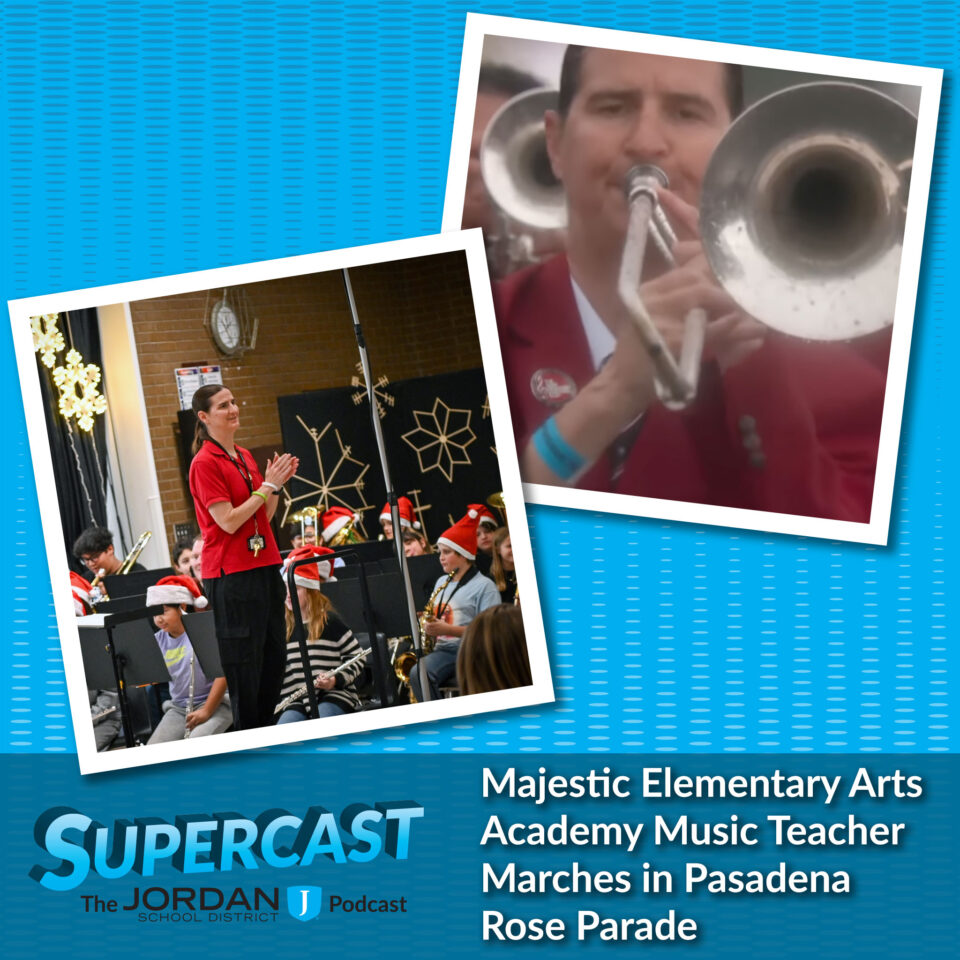
It is a high note in the very successful career of a Jordan School District music educator. On this episode of the Supercast, meet Majestic Elementary School music teacher Lisa Blodget who just returned from marching in the Pasadena Rose Bowl Parade.
Find out why Blodget was one of more than 300 band teachers and directors from across the country selected to march in the prestigious parade, and what it felt like to be on the national stage cheered on by thousands along the five-mile route.
Audio Transcription
Lisa Blodgett:
I was invited to participate with the Saluting America Band Directors Marching Band for the Rose Parade.
Anthony Godfrey:
Lisa's skills go well beyond her abilities as a musician.
Marianne Johansen:
Expectations without a doubt. That's what makes you such a great band teacher. That's what makes you such a great teacher overall. She expects greatness out of the kids.
Anthony Godfrey:
Hello and welcome to the Supercast. I'm your host, Superintendent Anthony Godfrey. It is a high note in the very successful career of a Jordan School District music educator. On this episode of the Supercast, meet majestic elementary school music teacher Lisa Blodgett, who just returned from marching in the Pasadena Rose Bowl Parade. Find out why Blodgett was one of the more than 300 band teachers and directors from across the country selected to march in the prestigious parade and what it felt like to be on the national stage cheered on by thousands along the five-mile route. We're talking today with Lisa Blodgett, a teacher at Majestic Elementary Arts Academy. Lisa, thanks for talking with us.
Lisa Blodgett:
Yeah, thanks for having me.
Anthony Godfrey:
You had a pretty exciting week. Tell us about what happened last week.
Lisa Blodgett:
I was invited to participate with the Saluting America Band Directors Marching Band for the Rose Parade on New Year's Day and was one of 360 band directors from across the nation. Actually, every single state had a representative plus there were some people there from Canada and Mexico also. So it was kind of a North America thing. We were all invited to come march in the parade, but it wasn't just we just showed up and march, we actually had a lot of preparations that we had to do beforehand to get ready for this event.
Anthony Godfrey:
So who was the director of the directors?
Lisa Blodgett:
So that's crazy because when they walked up and said, “Who's the director of those standing the line, everybody raises their hands.”
Anthony Godfrey:
Everybody raises their hands. Like, I'm the director.
Lisa Blodgett:
A gentleman that teaches at Bowling Green State University in Ohio. So this whole project started with a lady named Karen Suelle. And her husband was a band teacher and he passed away. He had taught for many, many years and he had passed away and she wanted to keep a memory of him going. So she created this foundation and they had this band march back in 2022. It was going to be a one-and-done deal. But it became such a thing and people across the nation started asking for it. They went to the Macy's Thanksgiving Parade and then it came back and the Rose Parade wanted it again. So they put the band back together again.
Anthony Godfrey:
Wow. We're getting the band back together.
Lisa Blodgett:
Yeah. They said getting the band back together and I had been it in 2022. I'm like, oh, that's pretty cool. And so I kind of had reached out a couple of years ago and said, hey, there's another event. You know, I'd be interested in being part of it if possible. And so I received notification a little over a year ago, “Hey, we've been invited to the Rose Parade” and there was an application process. So it wasn't just like, oh, yeah, I want to go do it. I actually had to submit an application. And so I put that in and sat and waited and waited and waited and waited. And a few months later, I got a “you've been accepted to come march.”
Anthony Godfrey:
Wow. That's exciting. So what sort of preparation did you do? How did you guys get together and practice when you're from far and wide?
Lisa Blodgett:
Yes. I never played with any of these people before.
Anthony Godfrey:
Yeah.
Lisa Blodgett:
And so they sent us out the music back in August, actually, and they let us choose a part or assigned us a part. And so we all pulled up our music and we had five songs and so we had five songs that we rotated through. And so we had to memorize each one of those because we were going and we're just playing no music in front of us. So it is a process of listening to the music, getting familiar with the music and then starting to memorize it. It's not something you can sit down and do overnight or in a week or two. So it's a matter of . . . And then not only it's a five-and-a-half-mile parade. And so there's the endurance of walking also. So they they encourage us to get out, start walking, get out, start walking 120 beats a minute. That's two steps every second. You don't understand.
Anthony Godfrey:
It's not a stroll and it's not a run. It's walking at a particular pace for a long time.
Lisa Blodgett::
And breathing and playing an instrument. So they're like, get out and start conditioning yourself, get the music memorized so that we show up that we're ready to rock and roll. So everybody shows up ready and prepared. So it's like when I'm teaching school too, you know, talking to my kids about, you know, we need to be prepared. If you're not prepared and you don't know your music, you know, your stuff, you know, we're not going to be as good of a group. So everybody that expectation is there is everybody showed up prepared. And so day one rehearsal, we're ready to rock and roll and just put everybody together into one piece.
Anthony Godfrey:
Did your neighbors say anything when they saw you walking down the street playing the trombone as a, you know, preparation for the parade or did they just figure, “oh, that's Lisa. There she goes.”
Lisa Blodgett:
I actually didn't take my trombone out in the neighborhood.
Anthony Godfrey:
OK. OK.
Lisa Blodgett:
I walked and I actually walked around the band room a couple of times in between classes.
Anthony Godfrey:
Was it more of a workout or less of a workout than you were expecting when you actually did it?
Lisa Blodgett:
Actually, the walking part wasn't too bad because I like to get out and I like to walk a lot. The part that was the hardest for me was the holding the horn and the horn angle up. You get a lot of kind of . . .
Anthony Godfrey:
Oh, yeah. You've got the upper body strength. That's a whole body workout.
Lisa Blodgett:
Yeah. So, holding the instrument up and then the first part of the parade, we continually played for the first mile and a half without stopping just because of all the TV cameras. You don't want to cut away. So as we went through camp, the first day we were rehearsing in California, I was like, oh, man, what did I get myself into? And day two was better day three. By the time we did the parade day four, it was great.
Anthony Godfrey:
Did everyone seem well prepared? I'm assuming so.
Lisa Blodgett:
Yeah. People came very well prepared. The first night we got together, they actually opened up three big ballrooms in the hotel and they set the block in chairs. So the block is as long as a football field. Essentially, that's how long because there's 360 people in the band, 12 people in a row. So they just set us in the hotel room and we all sat in chairs and watched the conductor and just sat down and started playing. And it just came. It came right together right away.
Anthony Godfrey:
So how many beats per minute, did you say?
Lisa Blodgett:
One hundred twenty beats.
Anthony Godfrey:
One hundred and twenty. Do you now walk at one hundred and twenty beats per minute just automatically?
Lisa Blodgett:
When I, when I go out, I would when I go walk, I'd actually sing the songs in my head. So yeah.
Anthony Godfrey:
OK, let's go walk a hundred and twenty beats per minute. Let's walk out of the office here for a second. OK, let's just walk at one hundred twenty beats per minute. I'll follow you. And while we're while we're walking at one hundred twenty beats per minute, what were the songs that you were playing?
Lisa Blodgett:
So we played a song that was actually put together for this particular parade called “Strike Up the Saints.” So it was a little bit of mixture of “Strike Up the Band” and “When the Saints Go Marching In.”
{SINGING]
Anthony Godfrey:
OK. All right. I'm holding my horn up. I'm already exhausted. So this is it's not like a super-fast walk, but it feels faster as you go along. You're keeping a good steady beat here. All right. Now I'm lost in the school as we're walking. I don't know where to go. So I'm going to keep following you. So everyone was well prepared. How many times did you practice and how much time did you spend practicing?
Lisa Blodgett:
So we practiced the first evening for two hours and then the next two mornings we got together. Actually three mornings and we spent about two and a half hours . . .
Anthony Godfrey:
Yeah.
Lisa Blodgett:
Average actually practicing through. But then we had other events we went to play to in the afternoon. So morning was rehearsal time and then afternoon is performance time.
Anthony Godfrey:
So that's a that's a lot of preparation leading up to not very much time together and a lot of opportunities to play.
Lisa Blodgett:
Right.
Anthony Godfrey:
Oh, here we're back at the principal's office. Poor Doug has been holding the microphone and walking backwards. We just finished our walk and that was not very long. And I actually did feel that a little bit, like just keeping that steady pace is different from any other walking even if you're walking for exercise.
Lisa Blodgett:
Yeah. And think about being rained on pretty good tips.
Anthony Godfrey:
Yeah. Now that's the other thing. It was raining hard on you guys. I understand that it stopped in time for the game but that wasn't your concern. The parade was soaked.
Lisa Blodgett:
Yeah. When we, as we are stepping up and waiting our turn to step off, the rain had slowed down and we had had some ponchos on and we pulled the ponchos off right before it was our turn to step up online. And then the rain just started coming down, and actually all the way through all the TV cameras the first probably mile and a half, it rained pretty good on us. And then it actually let up and finally stopped.
Anthony Godfrey:
How does the trombone sound in the rain?
Lisa Blodgett:
It sounds great in the rain.
Anthony Godfrey:
Good acoustics.? So the trombone seems tricky to me because you don't get to just push a button and now you know that that's going to you know your instruments going to play the right note. You have to get it to just the right spot. Is it as hard as I think it is to learn that?
Lisa Blodgett:
It's got seven positions. The trumpet has seven finger combinations and the trombone has seven trombone positions that you learn by feel. But you know there's a little bit of adjustment during . . depending on what partially you're playing on. But there's seven general positions to find yourself on.
Anthony Godfrey:
Does it throw you off to be walking at 120 beats per minute and have it angled up and have it raining and have the cameras on you?
Lisa Blodgett:
There's a little bit of thinking when you do all that stuff at the same time.
Anthony Godfrey:
I'll bet it's exhausting. But you did get some good camera time, I understand.
Lisa Blodgett:
I did. I was really surprised. So I landed a spot on the front row of all 360 people. There were 12 of us on the front row, and I was right in front of the camera.
Anthony Godfrey:
You showed me some of that before the interview, and that's pretty exciting. It's really cool for you to get that airtime. Well-deserved after all that work that you put in.
Lisa Blodgett:
Yeah, I shared it with the students today. I have the parade and I didn't tell them there was a big shot of me coming up and we were just watching it. And then all of a sudden, that face image comes up of me, and the kids all just went crazy. “Yes, Mrs. Blodgett!”
Anthony Godfrey:
I'm sure they were really excited. So when did you get back?
Lisa Blodgett:
I got back Saturday night late.
Anthony Godfrey:
So that made for a busy winter break for you.
Lisa Blodgett:
It was, but it was a fun winter break.
Anthony Godfrey:
Yeah unforgettable. Have you performed in parades before?
Lisa Blodgett:
I'm in the Army Band and so we do quite a few parades here and there. So it's not something I haven't done. Obviously, when I was in college I did a lot with the marching band and stuff. But having the experience with the Army Band, I'm doing a parade or two or sometimes up to six a year.
Anthony Godfrey:
Wow. So do you travel around doing that? Where have you done parades with the Army Band?
Lisa Blodgett:|
So mostly in-state because we're a National Guard Unit. Last year in 2024, there was an expert team of eight of us that actually went to Morocco to participate in the International Military Music Festival. Most of the bands had 30 to 60 people in it and there was eight of us. And we actually marched down the street, the eight of us playing, and we put on a little field show on to at the end where we performed for all the important people there. So that's the craziest marching thing I've ever done because it was such a small element.
Anthony Godfrey:
Well thank you very much for taking time to talk with us. Thank you for being such a great example to these students about how playing an instrument can impact your life in a positive way and create opportunities for you. Thank you for being such an important part of Majestic Elementary Arts Academy.
Lisa Blodgett:
Thank you. I love it here. There's great faculty here and great staff to be a part of.
Anthony Godfrey:
Stay with us when we come back more with Lisa Blodgett and her principal, Marianne Johansen.
Male Voice:
Never miss an episode of The Supercast by liking and subscribing on your favorite podcasting platform. Find transcripts for this episode and others at supercast.jordandistrict.org.
Female Voice:
In Jordan School District, communicating and connecting with parents is really important and that's why we're very excited about ParentSquare. ParentSquare has replaced Skylert as the district's new communication platform. With ParentSquare, you'll receive all District and school communication via email, text, and/or the app based on your preference. All messages can be translated to your preferred home language indicated in Skyward and it takes less than a minute to set up your notification preferences. You can use the ParentSquare app on any device. The app is available at parentsquare.com/sign-in. We look forward to connecting with you through ParentSquare.
Anthony Godfrey:
We're talking now with Lisa's principal, Marianne Johansen. Thanks for talking with us.
Marianne Johansen:
Anytime.
Anthony Godfrey:
Now, Lisa's skills go well beyond her abilities as a musician. Talk to us about her impact as a teacher here at Majestic Elementary Arts Academy.
Marianne Johansen.
Oh, how long is your podcast, Dr. Godfrey? I could go on for days.
Anthony Godfrey:
Never long enough for our listeners. They always wish it was longer.
Marianne Johansen.
I'm sure they do. I'm sure they do. Lisa makes such an impact here. She impacts our behavior in positive ways. She impacts our climate and culture in positive ways. One of the most easily measurable ways that she impacts our school is her ability to not only teach music, but math. She is a phenomenal math teacher. A few years ago, I overworked her by asking her to not only teach band, but teach math. I had a fifth, sixth split. The home-room teacher was teaching the sixth graders their math, while Lisa was teaching the fifth graders their math.
Anthony Godfrey:
It sounds like that went very well.
Marianne Johansen.
It went very well. The year before Lisa took on this little endeavor, 23% of our students in fifth grade made typical or better growth in math. And the year that Lisa took over, 72% of students of students in fifth grade made typical or better growth in math.
Anthony Godfrey:
Wow. You nearly tripled the percentage of students who...
Marianne Johansen.
And overshot the state average as well.
Anthony Godfrey:
Fantastic. Lisa, tell me about the relationship between math and music.
Lisa Blodgett:
Math and music really go hand in hand because you've got to be able to subdivide and break music down, and it directly correlates with how you work with math numbers and stuff.
Anthony Godfrey:
Is there ever a time signature that has an improper fraction, or is it always a smaller number on top of the larger number?
Lisa Blodgett:
No, there's not always a smaller number on top. Sometimes you're in 12/8 time.
Anthony Godfrey:
Okay. So sometimes there is an improper fraction. See, kids, we're combining math and music even as we speak on the podcast here.
Lisa Blodgett:
Yeah, and we can actually take a measure of... you know, you've got... music is mostly in 4/4 time, and we can actually take it and break down into fractions. And we'll teach them, you know, you've got one quarter, one quarter, one quarter, one quarter for the four beats. I've actually done with the kids in class before. I'll be like, "What's one half plus one quarter?" And, you know, "How much of the measure are we filling up?" I've actually made them figure math out that way.
Anthony Godfrey:
Now, that's really integrating the arts into instruction because a lot of times it's the pizza, "Okay, here's the pizza, and where's half the pizza?" But now you're saying, "Okay, let's look at this measure. Let's look at the music that you're playing and how that's divided up." That's really impressive that you're able to pull those things together.
Lisa Blodgett:
Yeah, and with the sixth graders, too, we get into breaking it in the eighths because there's more pieces there, and then we end up into the other time signatures they don't see very often. I even make them play in 5/4 time to stretch their abilities.
Anthony Godfrey:
That's great. What do you think makes her such a great math teacher?
Marianne Johansen:
High expectations without a doubt. That's what makes her such a great band teacher. It's what makes her such a great teacher overall. She expects greatness out of the kids, and because she cares so deeply about the kids, they rise to that occasion. That year she taught math, she had some kids who have really struggled to make typical growth or demonstrate their capacity and their knowledge.
Anthony Godfrey:
They had a history for years of not seeing the type of success that she helped them achieve.
Marianne Johansen:
Yes, sometimes I think we call them clickers. When they take the test, they're done in like 3 minutes because they just click all the things and then they submit the test. Lisa took the time. She hand-wrote a letter to every single kid in that class and told them what quality she saw in them and why she thought that they could do it. I didn't have a single kid finish that test quickly that year. I had every single kid really giving their all and really putting in the effort. Because the last thing any of our kids would ever want to do is let Miss Blodgett down. They love her and they would do anything for her.
Anthony Godfrey:
Well, that's it right there. That relationship and the expectations, and really creating an environment where the kids want to be at their very best. And they know that they have the help needed to do that.
Marianne Johansen:
Yes, they know that she will do whatever it takes. She's tutored kids after school. She's met with them during her lunch breaks. They know where to go if they need support, and they know where to go to get the help. They know that she believes in them and that she expects them to get there because she will help them get there.
Anthony Godfrey:
Sounds like a great candidate for Educator of the Year. Oh, wait! She has been Educator of the Year. No surprise that she has achieved that honor.
Marianne Johansen:
No surprise.
Anthony Godfrey:
Because really that's incredible what you've been able to do with those students. So thank you for that.
Anthony Godfrey:
Thanks for joining us on another episode of the Supercast. Remember, “Education is the most important thing you'll do today!” We'll see you out there.