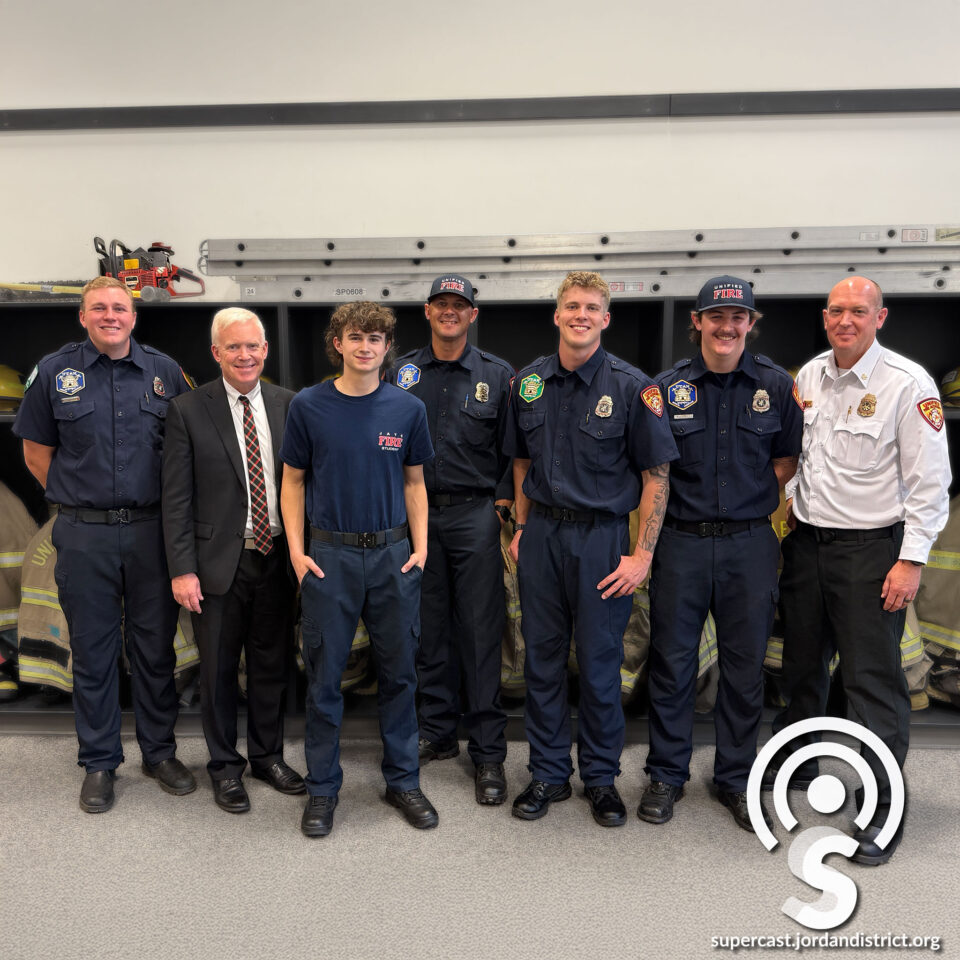
They were high school students already getting up close and personal hands-on experience at the Jordan Academy for Technology and Careers (JATC) in their quest to become firefighters.
On this episode of the Supercast, meet some recent Jordan School District graduates who spent this past summer on the front line fighting wildland fires in Utah. Hear how they got a jump start on their careers in high school, enrolled in the JATC Fire Science program. Find out what advice they have for current students eager to don their turnout gear and start their own careers as firefighters after graduation.
Audio Transcription
Sean Garrett:
This program is working and this is exactly what we designed it to be. Full-time firefighter EMTs for Unified Fire Authority that come from this program. All home grown.
Dalton Hendricks:
If you want to do this job, it's a really good opportunity to come here and further yourself and put yourself ahead of other people that also want that same job. Place just has so many of the aspects of the real job that we got to practice for two years.
Anthony Godfrey:
Hello and welcome to the Supercast. I'm your host, Superintendent Anthony Godfrey. They were high school students already getting up close and personal hands-on experience at the Jordan Academy for Technology and Careers in their quest to become firefighters. On this episode of the Supercast, meet some recent Jordan School District graduates who spent this past summer on the front line, fighting wildland fires in Utah. Hear how they got a jump start on their careers in high school, enrolled in the JATC Fire Science Program. Find out what advice they have for current students eager to don their turnout gear and start their own careers as firefighters after graduation.
Anthony Godfrey:
We are here at the Jordan Academy for Careers and Technology at the South Campus, talking with the Fire Science and EMT Program Coordinator. Go ahead and introduce yourself.
Sean Garrett:
Yeah, my name is Sean Garrett, and I am the Coordinator for the Fire Science and EMT Program at JATC out here at the South Campus. I'm a full-time firefighter with the Unified Fire Authority and with just under 19 years full-time experience.
Anthony Godfrey:
You were here previously and now you're back. Tell us about that. You were part of the original program.
Sean Garrett:
That's correct. So I actually graduated high school in 2002 at Riverton High myself and took this class there. It was just called South Jordan Fire Science. It was taught at the South Jordan Fire Department Station 61 at that time. Then with all the changes to districts and everything else, the Jordan School District didn't have a program for a number of years. It was 2012-13, and the principal at the time, Jason Skidmore, reached out to us because we had an internship program that we were running in the Valley for all the work-based learning and CTE students, and he wanted to start a Fire Science Program. So that's all she wrote. So myself and a few others built the program, put the curriculum together, and we started teaching at the North Campus and that first class was 2013.
Anthony Godfrey:
We're going to talk to some former students now who are firefighters. Talk to me about that.
Sean Garrett:
So I'm staring at them right now and, you know, these three buttheads, they were high school students here. I believe it was two years ago. Those kids were successful in this program. They graduated high school, moved on to our Camp Williams seasonal wildland program, worked on getting, finishing, testing, getting their EMT certification. Then once they had their two years seasonal, they ended up hiring on full time with UFA. Right before I came out here as a coordinator, I was a fire training specialist so I also got to be one of their lead instructors for their 16-week recruit school that they had when they hired on full time. So we brought them back here. They're, you know, obviously not just the story piece for sure, the recruiting piece, but just this program is working and this is exactly what we designed it to be. It was to give us these three over here that's standing over to your right. Like that's what we're supposed to have. Full time firefighter EMTs for Unified Fire Authority to come from this program, all homegrown.
Anthony Godfrey:
What a huge benefit to them and their families and to the community at large.
Sean Garrett:
And to be 20 years old and to start this career is, you know, it's not for the faint of hearts. It's hard on your body. It's hard on your mind. So, to start early on like that and to have a healthy 25-year career and get out of it with a pension and enjoy your life, like there's so many, so many takeaways from starting early and getting after it while you can, especially programs like this just taking advantage of the opportunities that are given.
Anthony Godfrey:
Well, it all comes down to the instructors. So thank you for making this opportunity possible.
Sean Garrett:
They're the ones that do the work, but 100%.
Anthony Godfrey:
We're talking now with three former students who are now firefighter EMTs. It's very exciting to have you here today. Just introduce yourselves and tell us about your current situation, where you are.
Dalton Timothy:
My name is Dalton Timothy. I graduated in 2023 from Mountain Ridge High School and attended JTech here for two years. I currently work with Unified Fire Authority and I'm all over the valley working on all the stations.
Carson Russell:
I'm Carson Russell, a firefighter EMT with Unified Fire Authority. I've been doing that for about a year. Currently right now I am all over the valley. I don't quite have a station to call my home yet. I graduated from Mountain Ridge High School in 2023 and did JTech for two years.
Dalton Hendricks:
My name is Dalton Hendricks. I am a firefighter EMT with Unified Fire Authority as well. I'm currently just roaming around all of the stations. I graduated in 2022 at Riverton High School and I attended JATC for my junior and senior year.
Anthony Godfrey:
Now tell me what it means when you are part of Unified Fire but you are not assigned to a specific station. How does all of that work?
Dalton Hendricks:
So how it works is you bid for stations and right now we don't currently have a bid. So that just means they fill you in at wherever they need a firefighter EMT, which is our rank right now. So, wherever somebody needs help then they will just fill us in. That's how that really goes.
Anthony Godfrey:
And you've worked on some wildfires. Talk to me about what you've been doing out there.
Dalton Hendricks:
So currently this year I was just on the Forsyth Fire down in Pine Valley. We were down there for 14 days. The work that we put in down there was pretty labor-intensive. We did a little bit of everything in the wildland world. We dug some hand line in the dirt. We put some water on some fire. And on top of that we also did some structure protection. So just wrapping structures, spraying them with water, making sure the fire didn't impact them at all.
Anthony Godfrey:
What do you wrap them in? Aluminum foil normally.
Dalton Hendricks:
Yeah, yeah, yeah. We'll do aluminum foil. We'll set up sprinklers on the roofs and stuff. So yeah, just stuff like that just to protect them.
Carson Russell:
You do a lot of mitigating around properties too as well in wildland. And we do that a lot here throughout the valleys. Just cutting down trees around, brushing, and getting rid of those things that could cause the house to spark up. Just to protect it a little more for those harsh conditions.
Anthony Godfrey:
And you talked about the digging that you do. What does that look like?
Carson Russell:
It's depending on the fuel type. So it could be from 8 to 6 inches and you're just getting down to mineral soil. So you're just getting all the duff and the grass kind of out of that way so that the fire has a place that it will kind of stop if there's nothing else to burn basically.
Anthony Godfrey:
Tell me about what it has been like to be assigned to your first fire after completing all of your training here and being hired as a firefighter.
Carson Russell:
It's pretty cool. Your body kind of goes into this, “I know what to do, and I know my role.” And then your kind of mind shuts off a little bit and you just go back to your training and kind of do what you remember. And then the wow factor just comes after. I just went into a house that was on fire and did exactly what I was supposed to and everything I needed to do, and got the fire out.
Anthony Godfrey:
You say that pretty casually. “I went into a house that was on fire.” That is the sentence I've never said. So you really do get into a mode where your body is just saying, "Alright, here we go. This is what we do."
Carson Russell:
Yep.
Anthony Godfrey:
You're not really evaluating. You're just doing what you know to do.
Carson Russell:
And there's always the little voice in your head that says, "Oh, make sure you're checking for this. Make sure you're doing this." And so you're still kind of with it, but your body just feels like it just knows what to do.
Dalton Hendricks:
Yeah, the first fire, once you kind of get out, there's a part of you that you have that moment where you're like, "Oh, this is happening." And then once you get there, it just becomes a task and you're just going at it step by step on what we're doing now to then what the next project is to what we're doing here. And eventually the fire's on. You're like, "That just happened." That's kind of crazy.
Anthony Godfrey:
And then you process all that for a long time after that.
Dalton Hendricks:
And you tell stories.
Carson Russell:
It's definitely for the first time because we go throughout training and we have props out at the fire training in Magna where we practice fires all day long. And you get used to—
Anthony Godfrey:
Out of the tower.
Carson Russell:
Out of the tower. You get used to those props. You're still doing the training and everything, but you go into these houses you've never been into before and it's completely blacked out inside. And you can't really see. You just have to rely on your instincts and your training that you went through to locate the fire and put it out. Yeah, it's definitely a whole other world.
Anthony Godfrey:
When you look back at your first fire and you think about your time here at JATC, did it give you the foundation you needed to be successful?
Carson Russell:
Yeah, it definitely was a start on the basics and when you get in those high stress moments when you're in that house fire where you can't see, you just got to go back to your basics. And it just becomes just like a habit. You don't really think about putting your jacket on in the morning. So when you do all these repetitions here at J-TEC and you keep doing that throughout your career, it really just becomes second nature.
Dalton Hendricks:
You're doing a lot of the stuff that you're doing out at the training tower, which we did for three months. You're putting on gear. You're getting on air. You're doing search drills. So you're following the hose. When you can't see inside of a house, you have one thing you can follow, and that's the hose. So if you don't know your way out, you can follow the hose.
Anthony Godfrey:
Follow the hose. Okay.
Dalton Hendricks:
We did a lot of that stuff here. We did search drills. We had a fire engine that we could practice on and do training. We pulled the hose off the engine, flowed the water out of it, just like the real thing. And we have a forceful entry door here. We have to force our way into houses. This place just has so many of the aspects of the real job that we got to practice for two years. When we went into fire training, we already knew how to put on our gear. We already knew how to do it in time. We knew a bunch of aspects. If you want to do this job, it's a really good opportunity to come here and further yourself and put yourself ahead of other people that also want that same job.
Anthony Godfrey:
A really strong head start. Fantastic. I'm so grateful for what all of you are doing. And I'm really glad that you came through this program and that you're out there keeping our community safe. So I am excited to continue to watch your careers grow. And thank you very much for taking time today. Thank you.
Dalton Hendricks:
Thank you.
Carson Russell:
Thank you for having us.
Anthony Godfrey:
We're talking now with one of the current students in our Fire Science Program. Tell me your name, introduce yourself, and tell me what interested you in being part of this program.
Jaden:
I'm Jaden. I've been interested in this for like a while. I've been wanting to be a firefighter since I was a kid. And my dad, he works in the military, and they have to like do fire operations there. And I just thought it was super cool. And I just thought I should be a part of it.
Anthony Godfrey:
So you were interested in this from an early age. And has your dad, as part of his military service, been a part of fire operations?
Jaden:
Yeah. He like really like lately, he's been sending me videos of him putting out fires on a truck. I just think it's super cool. Because he mainly did like the military stuff back then. He like showed me. And now he's like being more a part of it.
Anthony Godfrey:
How does it feel to him that you're in this Fire Science Program?
Jaden:
He thinks that I'm working a lot harder than he did back in high school. He thinks it's way better.
Anthony Godfrey:
Yeah. I like the sound of that. That you're working hard. There's a lot of discipline involved in this program. Talk to me about what that feels like.
Jaden:
So like in the mornings, we have to go in and they have to check our whole uniforms. We have to stand perfectly. There can't be any hairs, and they can dock us points for that. And like you can't be slacking like when we're pulling hose or doing anything. Because that can also dock you points and they will deal with you.
Anthony Godfrey:
Tell me about some of the lessons that you're already taking from this, about yourself, and just about life in general.
Jaden:
It's having me look like more forward. And not like kind of just like go by. You know and try to like make up my future instead of just let it happen.
Anthony Godfrey:
So you're a little more intentional about things and more thoughtful about what you want to do next. And what is that?
Jaden:
I think wildland. I plan on applying for this summer. It seems really fun. I hope I can deal with these guys. Whatever works.
Anthony Godfrey:
And that's some specialized training for wildfires.
Jaden:
Yes.
Anthony Godfrey:
And that takes place in the summer following this program. Do you think you want to be a firefighter perhaps?
Jaden:
Yeah. I think, I mean especially like I was saying with my dad. It goes from that and it just moves on up to Hazmat and all that. And I think I just want to keep going up.
Anthony Godfrey:
Fantastic. Well congratulations and I'm eager to see what happens next for you.
Jaden:
Thank you.
Anthony Godfrey:
Stay with us when we come back more with the firefighters trained at the Jordan Academy for Technology and Career.
Male Voice:
Never miss an episode of The Supercast by liking and subscribing on your favorite podcasting platform. Find transcripts for this episode and others at supercast.jordandistrict.org
Female Voice:
Does your student want to become a veterinarian, commercial pilot, programmer? Maybe they want to make a difference as a dental assistant. These are just some of the programs offered as part of Career and Technical Education, CTE, in Jordan School District. CTE provides the technical skills needed to prepare students for future employment or for a successful transition to post-secondary education. Career and Technical Education provides work-based learning opportunities. We partner with industry experts to offer apprenticeships and internships with students working in the real world at real jobs while going to school. The CTE experience starts in our elementary schools with the kids' marketplace and grows through middle and high school. To explore all CTE has to offer in Jordan School District, visit cte.jordandistrict.org today, and let's get your child started on the pathway to a profession.
Anthony Godfrey:
There are a lot of students who've continued with the career and even those who haven't, they learn skills that are going to help them through the rest of their lives.
Sean Garrett:
Yeah, for sure. Being an instructor here, for the number of years that I was and then now being the lead coordinator here, we're definitely, with the Unified Fire Authority, we're trying to home grow our future firefighters for sure. But the program itself, just the structure, the discipline, the teamwork, the social interaction with your classmates and everything else, we're teaching these kids skills that they can use in anything that they do. That's what we're really looking to do, just change a person's attitude towards something that they want. But definitely the goal is to yield people that come through our part-time programs and then eventually get hired full-time. And there are, I wish I knew, even that class we talked about, 2013, the OG back to back to Jordan School District Fire Science class. Sterling Smith was a student in that class and now he, not only is he a full-time firefighter and a promoted engineer, he finished this class, went to work at Camp Williams as a wildland firefighter. And now full circle, he's one of the instructors that I use out here to teach these kids. And the reason we have a complement of instructors is just when we do hands-on skills, we want to keep a ratio of instructors to students just because of the stuff that they do that's physical, just for the safety aspect of stuff. Same thing with the EMT, it's run through the State Bureau of EMS and you have to have a six to one ratio when you have skills. So we have a complement of, I think, 24 instructors throughout the three platoons from UFA. We typically have anywhere from one to three of them here with me every day, depending on what we're teaching that day. So, yeah, Sterling was from class one. Right behind us as we're talking, you can't see it, obviously, with those are part tags from students of the past.
Anthony Godfrey:
Oh, yeah, I see that.
Sean Garrett:
That was something that was kept up every year. And then probably say about four years ago, I think it just kind of, something kind of fell off the table. Now, being back to this, I think that we'll kickstart those traditions.
Anthony Godfrey:
That's a great representation of just a part of the impact that you're able to have. As you've worked with students over the years, and I know you experienced this yourself, do you find that they discover abilities and a disposition within themselves that they didn't know was there?
Sean Garrett:
100%. And that's one of the coolest things about this, regardless of if these kids end up being firefighters or not. Being able to see the nerves on day one and just the unsure. And there's also that intimidation factor, too. Like you get, you know, it's a kid that thinks that this is something that they want to do so they're here or they were unsure and they found their name on a registration piece of paper. And they're talking about, you know, we're doing PT assessments and pushups and sit ups and we do physical activity with these guys every morning. But you're looking, you know, the person on your right or left and it's some big kid that plays for the football team for their high school and there's that intimidation factor. But the way we go about stuff is there's not one way to do any of these skills and we work with them and we really don't, we don't care how many, you know, pushups you can do day one. You know, if you can't do them, we just, we just care that at the end of the day we got better. So you watch these kids progress through the quarters and through the semesters and at the end of the year, just the brother and sisterhood that they have with their classmates and just the confidence that they build themselves.
Anthony Godfrey:
That's worth it for sure. That kid's it's pretty rad to see. How does it feel when you see students become firefighters and instructors and become, like you said, become a homegrown addition to the profession?
Sean Garrett:
There's a lot of emotions. I mean, for sure it's like this. It's this it's this proud feeling because that was a lot of us came from programs like this. And we knew how much it meant to us when we were 17, 18, 19 years old and what it did for us now having a career in the fire service and how it's provided for me and my family and how it's given me a whole other family. So to see these guys go through and get hired, it's a sense of pride for sure. Like it was what it was designed to do, you know, bringing this program back in 2013. You know, this is this is what it's supposed to do. Yeah, this is what we're supposed to happen. You know, this is it's homegrown. It feels good. A lot of hard work goes into it. You know that they worked hard to get it. And a lot of emotions, but proud would be the word that I would use for sure. And a senior, the year that this started back up, would now be 30 years old. I mean, it's pretty it's pretty crazy to think about how fast time goes by and how quickly that that positive impact spreads. It, you know, we were just we use this building, our department, just the other night for a promotional ceremony. And there were a few people that had some speeches and you blink and it goes by. And like even now, you know, I'm hanging out every day with with my group of instructors that some of which I've hired on with some of some of them came from this class. Like you were saying, Sterling. And, you know, he's not only was I as high school teacher, but now, you know, he's he's a co-worker of mine and he's married, has three kids. Like it's wild. And it does. It just goes by so fast. It feels like it takes eons when you're in the middle of it. But then when it's all done and you look back, it just seemed like it wasn't that long ago at all.
Anthony Godfrey:
The time just disappears. What sparked your interest in this initiative?
Sean Garrett:
So I'm actually fourth generation firefighter. So my great-grandfather was a captain for Salt Lake City Fire. His two boys were both firefighters and has met specialists for Salt Lake City Fire. My grandfather is my mom's dad worked for the department that I work for, which was then Salt Lake County, now Unified Fire. He retired in 1999. My uncle was he's retired now, but worked with me at Midvalle Fire and Unified Fire.
Anthony Godfrey:
Wow.
Sean Garrett:
And here I am. I still have a cousin that's a battalion chief for Salt Lake City. And his boy also works as a firefighter for Salt Lake City. And then my son is a senior in this Fire Science and the class.
Anthony Godfrey:
Well, that is a really exciting family tradition and I'm grateful that Jordan District is a small part of that. So thank you for everything you're doing to keep our community safe and to help bring out the best in our students.
Sean Garrett:
I appreciate the opportunity and I'm here to work. And I have a huge passion for what it is that I do, which is all about people and helping people and solving problems. And if people, as long as people are showing up, I'll show up and continue to show them how to do it.
Anthony Godfrey:
Thanks for joining us on another episode of the Supercast. Remember, “Education is the most important thing you'll do today!” We'll see out there.
Sean Garrett:
Thank you.
Thank you.
(upbeat music)