
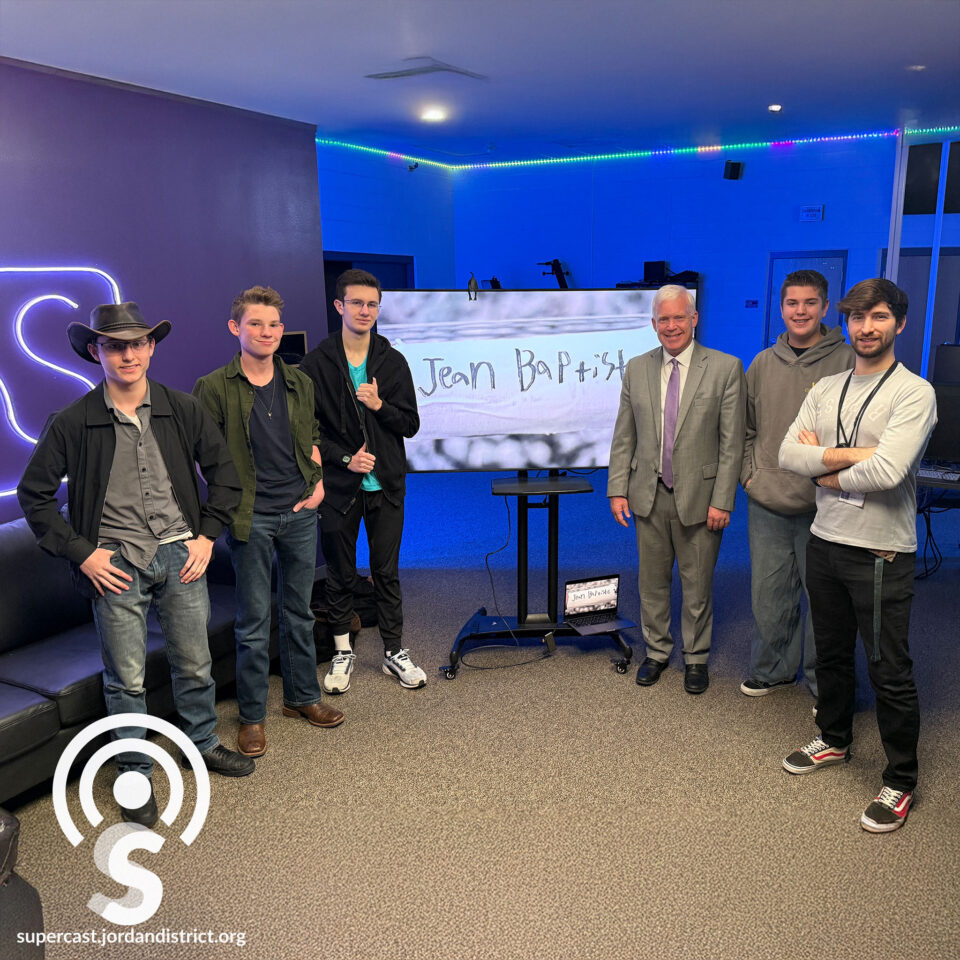
They are talented students being recognized on the world stage because of their passion for film making and for their amazing skills in storytelling.
On this episode of the Supercast, meet students in the Riverton High School video production class who just walked away with second place in an International Video Competition as part of the Student Television Network. Find out how a short horror film they produced is getting rave reviews and critical acclaim, with the students competing against young storytellers all over the world.
Audio Transcription
Mr. Luchs:
It's a competition between hundreds of different schools and thousands of students.
Student:
It had to be local folklore.
Student:
It was this guy that was exiled in like the mid*-1800s to like Fremont Island.
Student:
I think that that'd make a pretty good ghost story.
Mr. Luchs:
You spend those all-nighters making that color palette just right. That's the small details that separates you from, you know, sixth, seventh place or even two hundredth place.
Anthony Godfrey:
Hello and welcome to the Supercast. I'm your host, Superintendent Anthony Godfrey. They are talented students being recognized on the world stage because of their passion for filmmaking and their amazing skills in storytelling. On this episode of the Supercast, meet students in the Riverton High School video production class who just walked away with second place in an international video competition as part of the student television network. Find out how a short horror film they produced is getting rave reviews and critical acclaim.
Anthony Godfrey:
We're here at Riverton High School talking with students from the video production program. Introduce yourself, tell us what grade you're in, and what drew you to this program. Why did you want to be part of this?
Brennan Staggs:
Hello, I'm Brennan Staggs and I'm a sophomore and the thing that drew me into this program was the — I've always been into film so I think film is pretty cool.
Rockwood Inkley:
My name is Rockwood Inkley or Rocky and I'm also sophomore. The thing that drew me into this is I just, I love learning new types of art so I guess I saw this and thought it looked cool so I signed up.
Amden Olson:
Hi, I'm Amden Olson. I'm a sophomore and the thing that drew me to this is I've been doing photography for about two and a half years. I run an automotive photography business where we just started doing video so doing this helps me advance in my career and hopefully the video will be a pilot.
Scott Nelson:
Hello guys, I'm Scott Nelson and what drew me to this class was I've always wanted to be a filmmaker when I was a child and I saw that Riverton had video classes and thought it was really exciting.
Anthony Godfrey:
So tell me what it's like being in this class right now. What are some of the things you've learned and what you love most about it?
Student:
I think I've learned mostly on how to make better videos on film and that's what I love about it.
Student:
My favorite thing in this class is using Premiere Pro and post-production. I find it fascinating.
Student:
I enjoy this class because it has helped me learn more about video composition, which is some of the things that clients really like. If you don't have good composition you're not going to get clients.
Student:
I love this class because it lets me be creative in the morning and I've learned how to use the equipment and how to edit better.
Anthony Godfrey:
Tell me about the competition that you just won, the international competition that you just won and what that's all about and what you made that allowed you to win this competition.
Student:
This was a horror fest so we had to make a one-minute horror short film. It had to be local folklore so we spent a while, me and Brennan, spent a while looking for local folklore and we came across this story from the 1860s.
Student:
Yeah, around the mid-1800s. It was a, what was his name? Jean Baptist. It was this guy that was exiled in the mid-1800s to Fremont Island, I believe.
Student:
One of the islands in Salt Lake. He was a grave robber and he got sent to the island and they found a skeleton, I think, at the base of the Jordan River with the words "grave robber" in the skull and it was chained and shackled which they didn't send him to the island chained and shackled. So I thought that'd make a pretty good ghost story.
Anthony Godfrey:
Let's ask your teacher to introduce himself and tell us a little bit about the competition.
Mr. Luchs:
My name is Mr. Luchs. This is my fourth year at Riverton High School. I'm the video productions teacher and I love it.
Anthony Godfrey:
So tell me about the competition, what's involved and who were they up against?
Mr. Luchs:
Yeah, so the competition itself is for an international organization called Student Television Network. They have a lot of different competitions throughout the year. This one is their horror film competition. This one is very unique because throughout the year, their competitions involve lots of categories for all different types of video. And so though it's a competition between hundreds of different schools and thousands of students, your category often has a portion of those students. The horror film is unique because every student in every team is making the same type of prompt. These guys, to my understanding, were up against a couple hundred different first-year student teams, and so getting second place out of all those hundreds of teams, let alone many, many, many hundreds more of students, is very cool. They did have a set of requirements. They required, as they said, to find a local folklore and based the one-minute film on that. They were also required to meet certain story and recording-based specifications, which they did a very good job of doing. Or at least so the judges did.
Anthony Godfrey:
I already like the color tones here. Did you change the color tones at all or is this just what the Jordan River looks like? Because I'm already terrified.
Student:
I did the editing for this.
Anthony Godfrey:
Yeah.
Student:
So I get every question.
Anthony Godfrey:
How long, how much editing does it take for a one-minute horror video? Because I think people probably underestimate the time that it takes. At least three minutes, I would think.
Student:
I spent an all-nighter and half a day working on the editing for this.
Anthony Godfrey:
Does editing horror films require that you do it in the middle, in the dead of night, really? Is that when you should be editing a horror movie?
Student:
No, but I am the oldest of four siblings. So that's what I get.
Anthony Godfrey:
So you have to wait till it gets quiet.
Student:
So yeah, that's when I get the most peace and quiet to work.
Anthony Godfrey:
Okay, that sounds fair.
Mr. Luchs:
If I might jump in, I want to give these guys a lot of credit for what he said, too about working overnight and into another day. One thing that's really interesting about being a video teacher is you have students that come to get the grade, and you have students who really give themselves to their projects and program. This is one of many classes, and I didn't require them to spend hours and hours doing this. This was an optional competition.
Anthony Godfrey:
Yeah.
Mr. Luchs:
And he edited this during his fall break. So this wasn't just something he did on a whim. They really dived themselves into it. I think you guys had to record, rerecord like three different times to get all the shots that you needed.
Student:
Yes, we did have to rerecord three times. The first time we weren't very coordinated, and it ended up taking a lot more time to get us all in the right location. And our footage was kind of rushed and not very good. And the second time, the second time, was more like we had equipment malfunction and again, uncoordination. And then the final two times was when we had the actual footage that we filmed.
Anthony Godfrey:
So a lot of logistics, a lot of things to account for that you can't totally control always. And I appreciate that you went back to redo things. I think that's really cool that you dedicated as much time as you did.
Mr. Luchs:
Yeah, and I think that's really why they did so well, because like I said before, they are part of a first-year student film team. Everybody in this competition has, let's say six weeks of prior experience at most, depending on when their school year started. But what separates different first-year students from others is A) the passion and B) the commitment, because I can only teach them so much in six weeks. Their dedication to re-film, film again, get those extra shots that they think that they needed, to spend those all-nighters making that color palette just right. That's the small details that separates you from sixth, seventh place, or even 200th place in the competition. And you have to have skill. You have to have learned in your classes and pay attention for the time you have. But it's really that passion and dedication that makes them stand out.
Anthony Godfrey:
Stay with us. When we come back, we watch the horror video with the students who produced it.
Male Voice:
Never miss an episode of The Supercast by liking and subscribing on your favorite podcasting platform. Find transcripts for this episode and others at supercast.jordandistrict.org.
Female Voice:
Does your student want to become a veterinarian, commercial pilot, programmer? Maybe they want to make a difference as a dental assistant. These are just some of the programs offered as part of Career and Technical Education, CTE, in Jordan School District. CTE provides the technical skills needed to prepare students for future employment or for a successful transition to post-secondary education. Career and Technical Education provides work-based learning opportunities. We partner with industry experts to offer apprenticeships and internships with students working in the real world at real jobs while going to school. The CTE experience starts in our elementary schools with The Kids' Marketplace and grows through middle and high school. To explore all CTE has to offer in Jordan School District, visit cte.jordandistrict.org today, and let's get your child started on the pathway to a profession.
Anthony Godfrey:
So I see the big screen here that maybe we get to watch this video. Can we can we take a look?
Anthony Godfrey:
Wow. That was chilling. Honestly, honestly, I kind of got-- I absolutely got the chills watching that. So Rocky, you do your own stunts, I see.
Rocky:
Yeah.
Anthony Godfrey:
Falling on the bike there and you're a grave robber right out of the chute there. So it pulls us in right away and then pulls you in literally at the end.
Rocky:
Yeah.
Anthony Godfrey:
You know what, listeners, I can't describe it. You're just going to have to see it for yourself. Now, I want to ask about one special effect. You couldn't actually see your breath or you could actually see your breath.
Student:
I think I found a PNG GIF and just overlaid it on top.
Mr. Luchs:
Wow. I actually-- I didn't even know that they did that. That just goes back to the test to their attention in detail because there's some things that they weren't told they had to do or how to do it. And I guess they figured it out.
Anthony Godfrey:
Yeah, I was a language arts teacher and we used to do an exercise where you had to try to write a really short horror story. It's kind of the same thing where you only have so much time and you guys made the most of every second. It just pulls you in really fast. I really love that. I thought that was very cool. How do you guys feel about the final product now that you've put all this effort into it?
Student:
I saw this and I was really proud of all of the effort that Rocky and Brendan put into it. And I felt like they did a lot of things that I wasn't expecting in a good way.
Anthony Godfrey:
Wonderful. How about you two?
Student:
I'm really happy with the way it turned out. There were a few things we wish we could have done better.
Anthony Godfrey:
That's the art of sensibility. You're always going to tinker. You're always going to think, “oh, I could do this thing or I could do that thing.” There's always the director's cut that comes out later. George Lucas wants to put all the special effects in after the fact. Everybody thinks they could do a little better. But that's why you did so well because you're always striving to make sure that it's the best.
Student:
Yeah, I think the final product of the film is really, really impressive. I filmed some of it, Amden filmed some of it, and Rocky edited the thing, and when I saw the edited portion and the full final product, I was like, this is really impressive. I'm really proud.
Anthony Godfrey:
Hearing the story you based this on and then seeing the product, there's a lot of creativity between the source material and where we ended up. And it's really impressive. I'm excited to see what you guys do from here because that shows just a ton of potential. And speaking of that, are you all going to continue in video production going forward? In these video classes? Now, tell me about what you want to do. What are your goals? Let's start here because you've got a vehicle photography business. Is that right? I was just really excited once I finally got a vehicle, but you're already photographing them. So let's talk about that.
Student:
Yeah, me and my friend Hunter, we met doing aviation photography. So things like the fighter did some of the Air Force Base, the commercial planes of the International Airport, things like that. And we both showed a passion for cool cars like Mustangs, McLarens, Corvettes, things like that. And we decided to start a business to try to make money off of our photos that we would go to car meets and do . . . And it did decently well the first couple months we got upwards of 10, 15 clients. And then after that, we kind of dropped off a little bit because we started school. So we weren't able to take as many as often, but we still have a consistent one or two, maybe three clients a month.
Anthony Godfrey:
Okay, that's really cool. So they hire you to take pictures of their classic cars or their expensive cars to show them in the best light. How about the rest of you? What are you thinking about building on this success? Do you want to continue with this as a career as a class? What are you thinking?
Student:
Uh, yeah, I mean, I plan on taking Video 2 and 3. I really enjoyed this. I'd like to make a longer horror film. I, but yeah, hobby, just professionally, I'd love to continue doing this.
Student:
I'd also love to continue doing this, not just as a hobby, but maybe a career. I think a director of like a TV show or series would be an interesting career path.
Student:
I really like the art of video. I don't think I'm going to do it as a career, maybe like a hobby-istic side career, like get extra money and stay in the art.
Mr. Luchs:
Yeah, I was gonna say I you mentioned before that we're excited to see where these guys go and nobody's more excited than I am because I . . . because they're sophomores, you know, seeing them be passionate first off. Awesome. And I have two more years that we get to experience things. And so I'm glad they want to experience things because one of the hopes we have for the program is to help them understand where and how this can be a part of their life by the time that they leave and prepare them for that. And I'm sure many of these guys have a lot of different routes they're going to take, but they, they all have what it takes to get to those routes as we, as we keep going these next couple of years together. It's exciting to have discovered this talent and interest so early in their high school career so that they can capitalize on that. I think I mentioned this prior a little bit, but the type of student that we get here in the program is, is fascinating because it's not just the people who love like watching videos online or film. I've had a lot of students who love video, who give up because they didn't realize how much work it takes to do it.
Anthony Godfrey:
Yeah.
Mr. Luchs:
The students who stick around and really make this program what it is in our advanced classes, they're the ones with a lot of grit. I get people from anywhere from drama programs to yearbook, anybody from a lot of cross country kids. It's anybody who has that desire to make something good and is happy with that.
Anthony Godfrey:
Yeah.
Mr. Luchs:
I love recruiting those kids because you could have a silver screen class. For example, we make a school show and we only have 16 kids and they make a consistent show and they have awesome quality. We've really done some awesome things with that, but those 16 kids work so hard to make it happen.
Anthony Godfrey:
Yeah.
Mr. Luchs:
And I can't explain to you how hard it would be if those students weren't as invested as they are.
Anthony Godfrey:
Yeah. Tell me about your journey to become a teacher here. You said it's your fourth year here at Riverton. Talk to me about becoming a video teacher.
Mr. Luchs:
Yeah. So I actually have a unique story with video teaching because a lot of the time when you talk to a video teacher or even the CTE in general, they come from the industry where they've been working and they want to change things and they find out that teaching is a good path. I actually decided to start teaching video back when I was high school because I did my own video projects. I was a YouTuber. I was one of the first people to do really silly dumb videos with like gaming YouTube channel back before it was normal.
Anthony Godfrey:
Yeah.
Mr. Luchs:
And so you got a lot of backlash, but my dad supported me and I found out that I loved doing it not because I loved gaming or anything like that, but I love the art of editing and I loved being an entertainer and that led me to try out more types of video. And eventually I decided that I wanted to switch career paths and do something with video, but I also wanted to be a family man and the freelance lifestyle didn't suit me personally. So, I had the thought one day to teach and I would talk to people and outside of Utah and outside of states like Utah, California, Florida, probably there's not as much CTE as we have here. So nobody had ever seen video classes in high school, maybe just the morning announcements that are, you know, sure. But I would talk to people and I'd say, “Hey, I want to be a teacher.” And they're like, “Oh, that's awesome. What do you want to teach?” I'd say, “Oh, I want to teach video.” And they would stare at me like, “Oh, good luck with that.”
Anthony Godfrey:
Yeah.
Mr. Luchs:
And here we are, you know, full-time film schedule. I teach so many cool things. I love it. Being a teacher is such a good, good life. It really is.
Anthony Godfrey:
Tell me what's next for this program. Obviously, I can tell that you've been modifying and adapting and making other options available. What do you hope to see in the future?
Mr. Luchs:
Yeah. So we've been so fortunate to be supported in all the growth that we've been doing from reconstructing the room to building new classes. We're at a point that everything's settling down. We've built up the program to what you wanted to be. And the future is really making student experiences shine. These students that have done the Horror Film Fest, they have two more years and can't be more excited about it because their possibilities, there are so many different directions they can take even just in the one program. For example, during Video 2 Film, we teach them a lot of hands-on advanced skills for filmmaking, commercial making podcasts, special effects. But a really cool direction that we do uniquely at this school is we study the industry and career paths. And we do that by first, we give them clients from the real world. My video to students are actually in a couple weeks about to start filming for companies outside of Riverton High School to make commercials for them. That starts a real-world portfolio that they can use to start making money if they want to.
Anthony Godfrey:
Yeah.
Mr. Luchs:
Because nobody hires you until they see what you have to offer.
Anthony Godfrey:
Right.
Mr. Luchs:
So we're going to teach them that. We're going to teach them how to work with people outside of a teacher in terms of client. Then beyond that, we're going to start doing Zoom video calls with a variety of video professionals in Utah. And we're going to talk to them about their career path, what their job looks like. That way, students can start seeing what video actually means in the real world and whether it's for them or which path that is because there's so many paths of video.
Anthony Godfrey:
I love the way that you build those experiences. Let's teach you some skills. Let's get you in some competition. Let's have you work as a team. And then I'm going to create a pathway. If you want to make money doing this on the side or as a career, that's something you can absolutely do. And you just lay out the path for them. I think that's really exciting. And we've talked about the passion that these kids have shown. But it's really exciting to see your passion for this program and to really help bring out the best in students. So thank you for being here and for everything you're doing. I'm excited to watch where this goes.
Mr. Luchs:
Thank you. I'm living that dream like we talked.
Anthony Godfrey:
Thanks for joining us on another episode of the Supercast. Remember, “education is the most important thing you will do today!” We'll see you out there.