It serves as a leader across the country and around the world for the education of students who are deaf, hard of hearing, deafblind, blind, or low vision and offers support to students in Jordan School District as well.
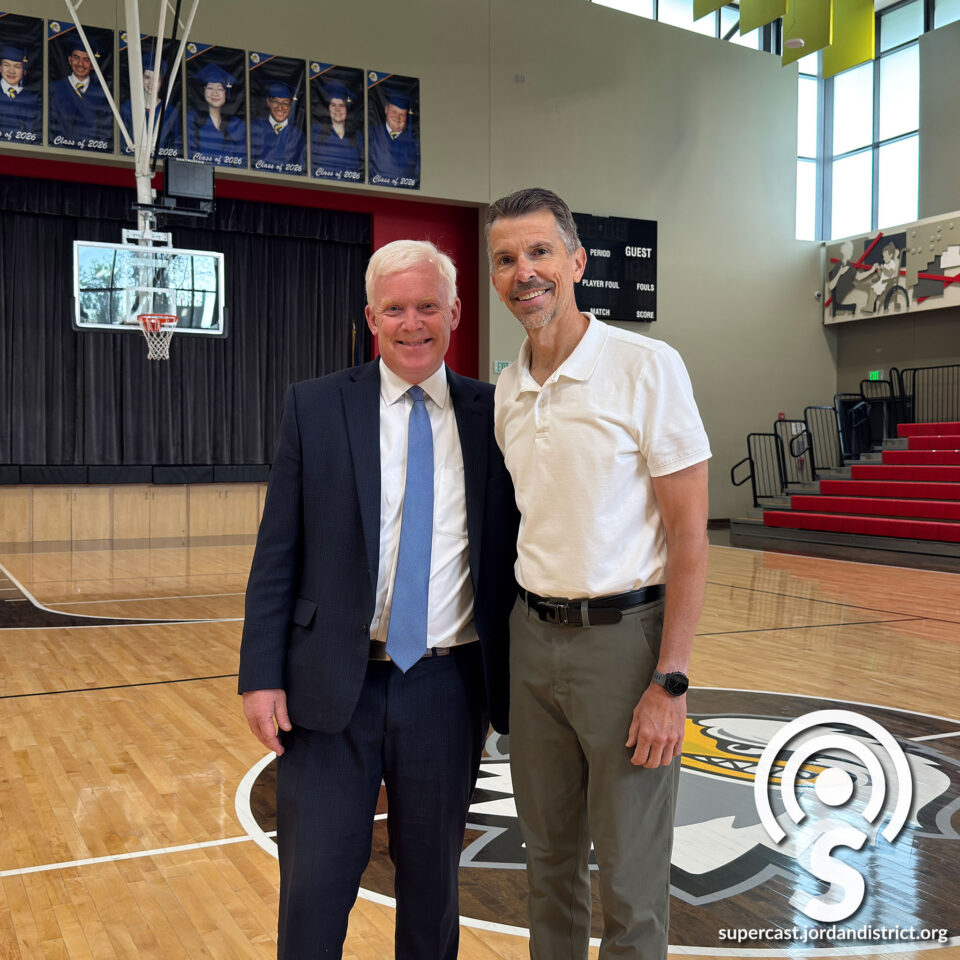
On this episode of the Supercast, we sit down with the new Superintendent of the Utah Schools for the Deaf and Blind. Find out about the incredible things happening every day at the school, how their services benefit students throughout the state, and follow along as we get a personal tour of the school’s Millcreek campus.
Audio Transcription
[MUSIC PLAYING]Darin Nielsen:
Got what's called a statewide multi-campus model. Utah has had a strong interest in supporting some of our students who have these communication or sensory losses since before we became a state.
Anthony Godfrey:
That's remarkable.
Darin Nielsen:
I'm really proud to be in a state where that's true.
Anthony Godfrey:
Absolutely.
Anthony Godfrey:
Hello, and welcome to the Supercast. I'm your host, Superintendent Anthony Godfrey. Students who are deaf, hard of hearing, deafblind, blind, or low vision are supported in Utah in a unique way. On this episode of the Supercast, we sit down with the new Superintendent of the Utah Schools for the Deaf and Blind. Find out about the incredible things happening every day at the school and on their campuses throughout the state, and how their services benefit students everywhere in Utah. Follow along as we get a personal tour of the school's Millcreek campus.
Anthony Godfrey:
We're talking today with the Superintendent of Schools for the Deaf and Blind here in the state of Utah. Please introduce yourself and tell us a little bit about your journey here.
Darin Nielsen:
Oh, yeah. Great. My name's Darin Nielsen. I'm in my 31st year of education. I started out as a school counselor at Teton High School in Driggs, Idaho, way back in '94, '95. I came back to Utah, which is-- I'm from Utah originally, my wife and I. And I'm working in Box Elder School District for 21 years in a variety of positions. Maybe one of my favorite was elementary principal, most enjoyable. But I started with the State Board of Education in 2017 as the Assistant Superintendent of Student Learning. And then this past year with some changes here at the Utah Schools for the Deaf and Blind, was asked to come over here around October in kind of a temporary or interim role. Then they opened the position formally after the legislative session and was appointed here in the May board meeting for the Utah State Board of Education.
Anthony Godfrey:
Well, congratulations. And tell us about Utah Schools for the Deaf and Blind. I think it's a unique model. And I think it's one that a lot of people probably don't understand.
Darin Nielsen:
Yeah. Yeah. So maybe one of the most interesting things about the Utah Schools for the Deaf and Blind is it actually was founded. The Schools for the Deaf was founded in 1884. Then the Schools for the Blind was founded the same year that we were put in statehood, which was 1896. So, Utah has had a strong interest in supporting some of our students who have these communication or sensory losses since before we became a state.
Anthony Godfrey:
That's remarkable.
Darin Nielsen:
I'm really proud to be in a state where that's true.
Anthony Godfrey:
Absolutely. Tell us about the service model here in Utah for those who may not be familiar with it.
Darin Nielsen:
OK. We've got what's called a statewide multi-campus model. Some states will have a single campus. And students who are in need of those services will be transported there. And there will be residential students on that campus. You can imagine how challenging that would be for children and also for families to have that kind of separation. So Utah, the culture of Utah has really been family first. It's my experience growing up here and then also being a parent of five children in the state. So to have a multi-campus model that puts the services closer to where students live is really a reflection, again, of a value of the citizens of the state of Utah. So we have a campus in Ogden, a campus here in Salt Lake or Millcreek, a campus in Springville within the Nebo School District boundaries. And then we have one down in Washington County. We have a portable classroom at Bloomington Hills Elementary School, Washington County School District. It's been a great partner with us. And so we have a portable there on their campus. And then we have students in this past year at Snow Canyon High School. We had a classroom there where we were serving some students who were deaf, hard of hearing in that environment. We also have a temporary classroom in Carbon County in Price to help provide services to those students. And then -- those are for our campus services. But we also serve-- in fact, the majority of students we serve, we serve in their neighborhood schools through what we call outreach. So we provide outreach educators across the state of Utah. And they'll come in and they'll provide support to the students so they can be successful in what we would call special, the least restrictive environment, which is always a goal of that type of education. And then it might be interesting to some people. We actually begin providing services when children are born if they're identified as having sensory loss. We have great relationships with hospitals and other private service providers. And we're put in contact with parents. We provide what's called a Parent Infant Program. We begin training parents and supporting parents at the time of birth. So the PIP program or Parent Infant Program serves birth through three. And then we go into preschool services and then eventually K-12.
Anthony Godfrey:
Amazing. Do we have any residential schools where students come and live?
Darin Nielsen:
Yeah, we do. We have on our Ogden campus, we have cottages, residential living for both students who are deaf, hard of hearing, and students who are blind, low vision. It's a small number of students that fall into that category of services. Might be also interesting for the community to know that students get placed within our programs through their neighborhood schools. So we, unlike charter schools or other entities that go out and recruit students, we don't do that. We are part of the Individual Education Programming services for children. And they get access to our programs through their local school districts. So those teams, which include the parents, make decisions about what services students need and where is the best place for them to get those. So we do have some students that live in our cottages, our residential life up in our Ogden campus. They'll typically come in to us on a Saturday, a Sunday night. Our transportation looks a little different, too. We don't have big yellow school buses. We have vans, because our transportation often is point to point and it's often one or two students per route because—
Anthony Godfrey:
Point to point, meaning you pick them up right at their home and bring them right to school.
Darin Nielsen:
Right to the door so they're not out at a bus stop typically. And they'll come from all over. We've got a student this past year that their home is down in Southwest Utah, I think south of Blanding. For that student, their family and education team made a decision that would be best for that student to come up and receive services during the week. But that's rare. We also have some neighboring states that -- we have two students from Wyoming this past year that Wyoming wasn't able to meet their educational needs. So they contract was Utah, pay the full cost of services. And we have a couple students that come to our campus in Ogden from Jackson Hole area, Star Valley area, and spend the week and then go home.
Anthony Godfrey:
How many students do you serve total?
Darin Nielsen:
Yeah, that's a great question.
Anthony Godfrey:
To varying degrees, because obviously there are different service plans for various students, depending on their needs and their location.
Darin Nielsen:
Yeah. Yeah, our total students statewide, this would include our Parent Infant Program, preschool, our campus students outreach this past year. Well, the past year being from our annual report from '24, '25 was 2,218. And across the course of the year, we served 415 students on our various campuses.
Anthony Godfrey:
So 415 on campus and about 1,600 not on—
Darin Nielsen:
Through outreach services.
Anthony Godfrey:
--campuses throughout, yeah.
Darin Nielsen:
So this past year, there were 71 students from Jordan School District that we provide outreach services to in their schools within your boundaries. And in that case, traveling, a lot of times, they'll have more than one student in a school, in a particular school. And it's pretty close geographically. All the traffic can be challenging in these urban areas. But it could look a lot like you're and out back in a day, and you're in multiple sites in a day, and less burdensome. And then in southeastern and southwestern Utah, we can have an educator that might have to drive half a day for one, to provide services for one student.
Anthony Godfrey:
Well, the bottom line is that wherever you are, whatever your needs are, we're going to find a way to come to you or to make sure that as a student, you're able to come to those services, if that's what you prefer. I love that it's been happening since before we became a state, that we've been trying to meet the needs of students who are deaf, blind, or limited vision, or hard of hearing.
Anthony Godfrey:
Stay with us when we come back. We'll tour the Millcreek Salt Lake campus of the Schools for the Deaf and Blind.
Male Voice:
Never miss an episode of the Supercast by liking and subscribing on your favorite podcasting platform. Find transcripts for this episode and others at supercast.jordandistrict.org.
Sandy Riesgraf:
Hello, I'm Sandy Riesgraf, Director of Communications for Jordan School District, and we want to invite you to connect with us. So many exciting things are happening in your child's school, your neighbor's school, in every school here every day. Don't miss out on following the fun or simply staying informed when there's important information we need to share. Join us at jordandistrict.org or follow us on Facebook, Twitter, and Instagram @Jordan District. We can't wait to connect.
Anthony Godfrey:
As you come into the position, what impact have you seen these educators have on students and families?
Darin Nielsen:
Yes, I'll share a couple of examples. One of our Parent Infant Program nights that I attended back in, I think, January. I had the privilege of sitting at a table with two sets of parents. One was a very young parent. Reminded me of my youngest son. They were probably in their early 20s. It's their first child who's dealing with blind, low vision issues. On my right side and then on my left side, I've got parents that are closer to my demographic. This is not their first child. It's not even their first child that's been dealing with vision loss. So, they've been connected with the Schools for the Deaf and Blind through a prior child. So they're kind of like the experts on this. Both sets of those parents, sitting between them, listening to them talk about their experiences and what the services the Schools for the Deaf and Blind are providing. That's through the PIP, that Parent Infant Program. They got emotional about that. And watching their children who were sitting there with them, if you would have been watching from a distance and just kind of observing, you might not even have known that they had that sensory loss. Then at graduation this last year, we had 17 graduates, all from our Schools for the Deaf, hard of hearing. Did it here in our gymnasium. And one of the unique things about our graduation is every graduate gets to speak. You can't do that in—
Anthony Godfrey:
That would take a while for most of our schools.
Darin Nielsen:
So they all get to speak and in this case, usually through ASL. And then an interpreter for those of us who aren't fluent in that language ASL. But listening to them talk about the experiences they've had over the course of their full educational continuum to this point, and talk about individual teachers and services. Some of them talked about their enrichment programs that we've mentioned that we discussed earlier. Some of them had taken them some years ago to Japan on an international trip, which they brought up. And the relationships that they were able to establish with their peers. Because here on our campus programs, especially deaf, hard of hearing, have the opportunity to have more natural relationships with peers because they can communicate directly with them without the use of an interpreter.
Anthony Godfrey:
Yeah. We talk a lot about a Portrait of a Graduate in this state. When someone graduates from Utah Schools for the Deaf and Blind, what do you hope they take away from their experience?
Darin Nielsen:
Yeah. Well, we also have a Portrait of a Graduate for our Schools for the Deaf and Schools for the Blind. Interestingly enough, they both developed-- both of those schools developed those before I came here. But I know that we hope that just like every parent, we hope as we work with the parents, we hope that they leave our educational system ready for the next step in their lives. Whatever they've chosen that to be, that they're able to be productive, happy individuals that contribute to the community in response to what our taxpayers who pay for these services hope that we are aligned with that as well. In our case, we hope they have accessibility, increased accessibility to the world, and also to relationships and people through the things they've been able to learn here and the programs we've been able to provide for them.
Anthony Godfrey:
I love that. Let's take a walk through the facility and get to know the school a little bit.
Darin Nielsen:
This is space we have here. Obviously, the gym and the area down there. And then on this—
Anthony Godfrey:
So it's kind of a home base for educators who travel and are helping at various locations.
Darin Nielsen:
Our outreach educators are in northern Utah. This is kind of a home base where you'll see on a work day, you'll see them at different stations, sometimes doing ASL.
Anthony Godfrey:
It's a beautiful open space here. It's nice.
Darin Nielsen:
Yeah, and one of the things that I noticed, especially at the Ogden campus, being somebody who's not as sensitive to accessibility as I should be or could be, I walk into the building. I've started to become much more conscientious about colors and changes on corners and for blind low vision as students. Something like when we put up our Christmas tree in the front entry of the Ogden campus, you have to think about that's now in a space that people are comfortable walking through that are blind. And so to acknowledge that, we put pine scent on the tree so you'd be able to smell that there's something—
Anthony Godfrey:
I see.
Darin Nielsen:
--in front of you. They have their canes as well that help them avoid—
Anthony Godfrey:
I'm sure you look at public spaces in a very different way.
Darin Nielsen:
Oh, yeah. Yeah. Let's go down these stairs. Used to be a charter school and was acquired by the state. It's our largest campus program for our students who are deaf, hard of hearing. Not surprising because we're in the urban areas. We have a lot of student population.
Anthony Godfrey:
So now we're in the older portion?
Darin Nielsen:
Yeah, our AMS building. This space is dedicated for our students who are deaf, hard of hearing. We provide services K through 12 over here.
Anthony Godfrey:
What do services look like over the summer? You have the camps?
Darin Nielsen:
Yeah, you see here that just like your buildings, your custodial, your facilities team is doing all their deep work in the summer. So the space inside the building is less available. But we do-- we have camps that we provide. Because our students are located across the state, a lot of our camps are spread out. We will put them in different locations to try to become more accessible or available to students that live outside or off of the Wasatch Front. A lot of times we'll partner with those camps, with other entities that provide services to students as well.
Anthony Godfrey:
Well, thank you for hosting us here. And it's really nice to-- I've never been to this building. And so it's really nice to be here and learn more about the program and the people and the services that you provide. This is probably not where you expected to be when you started off. But I'm very glad you're here serving our students.
Darin Nielsen:
I feel very fortunate to be able to spend some time with these great people and students and families here.
Anthony Godfrey:
Thank you.
Anthony Godfrey:
Thanks for joining us on another episode of the Supercast. Remember, “Education is the most important thing you will do today!” We'll see you out there.