Did you know the Utah Trust Lands Administration manages millions of acres of land, and through the leasing and sales of that land, they raise hundreds of millions of dollars that go directly into K-12 schools in Utah?
On this episode of the Supercast, we head to Hidden Valley Middle School to show you how School Community Councils, along with the school principal and teachers, decide how to use the money. Find out why Hidden Valley Middle’s School Land Trust Program stands out among others in the State thanks to dedicated parents and how, in the end, students in the classroom are clear winners.
Audio Transcription
[MUSIC PLAYING]Liz Mumford:
Utah is the only state that has a Community Council program where trust funds go directly to a local community to make the decision.
Bree Ervin:
So it is really nice to see that this is not just words on paper, it is action.
Anthony Godfrey:
You're already seeing an impact with your children.
Julianne Best:
And the way that we're doing things, he's getting it.
Anthony Godfrey:
I love that.
Julianne Best:
Showing a big difference.
Anthony Godfrey:
Hello, and welcome to the Supercast. I'm your host, Superintendent Anthony Godfrey. Did you know the Utah Trust Lands Administration manages millions of acres of land? And through the leasing and sales of that land, they raise hundreds of millions of dollars that go directly into K-12 schools in Utah? On this episode of the Supercast, we head to Hidden Valley Middle School to show you how School Community Councils, which include parents, teachers, and the principal, decide how to use the money. Find out why Hidden Valley Middle School's Land Trust Plan stands out among others in the state, and how, in the end, students in the classroom are the clear winners.
Anthony Godfrey:
We're talking now with the director of the advocacy office for the Trust Lands system. Introduce yourself and tell us a little bit about what that means and what your job entails.
Liz Mumford:
Yeah, thanks, Dr. Godfrey. It's great to be with you today and talk to the Jordan community. I am Liz Mumford. I represent all of the beneficiaries across the Trust system. That means public education and other state institutions that get distributions that come off of the revenue from Trust Lands.
Anthony Godfrey:
And talk to people about what Trust Lands are.
Liz Mumford:
Yeah, Trust Lands is a great story. It goes clear back to the history of our country and the origin of states. And when states came into the union, there was a recognition that they needed some kind of revenue to be able to fund important functions like public education and hospitals and higher education. And so the federal government granted lands to each state at statehood. And if you were to look at a map of Utah and see little sections of our state, you'd see this checkerboard pattern where, in every single township, four parcels were granted to public education to help fund public schools. And eventually, that was formalized into a trust and an endowment system. And that's where the money comes from each year.
Anthony Godfrey:
Parcels in every township, I didn't realize that the distribution looked like that.
Liz Mumford:
Yeah, it's really interesting. Some states, when they came into statehood, just received one section. But there was this understanding that we were an arid state, that land might not have as many natural resources. And so the federal government granted four sections in every township for public education.
Anthony Godfrey:
And how does that system work now? Explain to folks what that means for us in schools right now.
Liz Mumford:
Yeah, let's kind of talk about how Trust Lands, the administration makes money with those lands in this time. So there's a lot of different activity happening on those lands. Everything from oil and gas drilling, there are some coal mines, there are sheep and cattle grazing permits, there's geothermal production, there's real estate development. Critical minerals are an emerging opportunity for revenue on Trust Lands. And they are constantly looking for the highest and best use of activity in those areas. It's an important part of county economic development, and that supports taxes in schools as well once those businesses become functional and they become part of the tax base. But all across Utah, there's economic activity happening on Trust Lands. Each year, the Trust Lands Administration takes that total revenue that they earn on the Lands and transfers it over to an investment office. And that's known as SITFO, and it becomes part of a permanent fund for public education.
Anthony Godfrey:
And those funds have grown dramatically in the last 20 years, I would say. Even in the last 10, there's been a huge uptick in the amount of funding that's available.
Liz Mumford:
Yeah, that's a great point to make. So part of that is just the sophistication of their investment policy over at SITFO. So they manage that permanent fund, and they're managing it with experts in their industry. It also is the power of compounding. And so what we're seeing is the fund itself is creating increasing opportunities every year. It's up to almost $4.8 billion.
Anthony Godfrey:
Wow. And the distribution is a per-student distribution throughout the state that goes directly to schools to be administered through the School Community Council. And for the benefit, for academic benefit for students. So talk to us about that process.
Liz Mumford:
Yeah. So in state code, there's a formula that they use each year to determine that distribution. And some of your listeners may remember a few years ago, they voted on Amendment B. And that was an increased percentage that went out to public schools each year. So there's a formula based on student enrollment, the balance in the account, and on that statutory formula with 5%. And each year, SITFO calculates the total amount that would go out to public schools. And then there's a formula that dictates how much goes out to students. So this year, it's about $200 per student that's going out to Community Councils. And you hit it right on the head. It's the greatest academic need. That's their priority is crafting a plan, setting goals within your school community, and figuring out what are places where you can amplify funding that's coming from the legislature and other avenues, and meeting the needs within your school.
Anthony Godfrey:
And within these agencies that you've described, or working with these agencies, you're our advocate to be sure that schools are receiving what they should be, and that we're really focused on making sure that revenue is handled well and goes where it should.
Liz Mumford:
Yeah, that's a great point. It's a complex system here within the Trust. And so Trust Lands Agents Administration really focuses on the land management. SITFO really focuses on the fund investment. The School Children's Trust Program at the State Board of Education, they train councils, monitor the spending, and track compliance, and support good plan development. And our office serves as the independent advocate. There have been times in the history of the Trust system where lands were sold for less than fair market value, or there were risks in the system that compromised the value. And really, as the Trust system has become more formalized, and all these structures are in place, part of our role is just to protect the system, to make sure there's good governance, to make sure there's good policy. We work a lot with legislators on an annual basis looking at the Trust system and the statutes, and ways that we can just make sure the revenue continues to increase, and public schools get the money that they're guaranteed through this program.
Anthony Godfrey:
And with all these processes, and with your advocacy, and with good coordination among these offices, we have a trustworthy Trust.
Liz Mumford:
We do. It's amazing. When you look across the United States of America, Utah is the only state that has a Community Council program where Trust funds go directly to a local community to make the decisions. And that's really powerful. I think it helps strengthen our school culture. It builds parent engagement, and really lets us address things in a case-by-case basis.
Anthony Godfrey:
If I may insert this here, cue the old-timey music. But in the 1990s, back in the 1900s, Jordan School District actually pioneered the School Community Council. And that then was put into law later. But they were called School Community Groups. So you used to be able to know who'd been working in Jordan for a very long time if they called it a School Community Group. And then when it was put in law, it was a School Community Council.
Liz Mumford:
Yeah, that's so great. So many people in our state were part of that important transition. PTA was a huge element of fighting for Community Councils and for also just creating the modern Trust system in the 1990s. And it's just evolved over time and become more and more effective at getting the money down to the school level. I know when I started serving on School Community Councils 20 years ago, we were just receiving a small amount of money each year. And you might be able to buy some books or a software program or do a parent night with science or something more programmatic. And the money is to a level now where schools are able to invest in full-time equivalents. They're able to hire a teacher, pay for productivity . . .
Anthony Godfrey:
Lower class sizes.
Liz Mumford:
Lower class sizes, hire interventionists to help with reading. It's really powerful money that they can count on from year to year. And that's changed how impactful their plans can become.
Anthony Godfrey:
And over the years, as the amount of money coming to schools has grown, we've talked with principals about this is money you can rely on. The exact amount per student is going to vary. But you can feel confident hiring staff. Initially when we were switching from books and supplies to staff, it was a bit of an adjustment because it's a different source of funding. But there's a huge impact, a huge positive impact in our schools because of this funding. And as you said, it's a really important point. Jordan had a role. PTA had a huge role. The legislature putting it into law so that everybody has access to a School Community Council and can access these funds in a meaningful way. It was a lot of groups coming together to help public education. And that's really inspiring. And it's been very successful. And I appreciate the role that you play in making it such a success.
Liz Mumford:
Thank you. Well, we just believe that advocacy and understanding of the trust is so important. So when teachers in Jordan and parents in Jordan understand the Trust system and become champions for this program, it helps all of us protect the Trust and the school children's interest in it. So we're excited about the future of the Trust as the fund continues to grow. And we just believe that parent engagement and teacher participation in developing these plans collaboratively with principals is a huge part of that success.
Anthony Godfrey:
Now, you talked about being on a School Community Council 20 years ago. Is that what started you along this path to this position?
Liz Mumford:
Yeah, it really is. My background was being a parent. I had four boys that were all students in public education. And I got involved initially with PTA. And then I added that Community Council to that service. And they really complement each other well as PTA's work together in conjunction with Community Councils to support schools. But Community Councils really have this great role of greatest academic need. And I loved being able to influence decisions at my school. And it also becomes a place to talk about school issues, whether those are traffic drop-off issues or different things within a school community. And so I loved that opportunity. Eventually, I worked in a school and became a part of the plan as an educator, and then had an opportunity to review plans as a local school board member. And so I really watched the process from all different levels. And I think that's what makes the plan so cohesive and impactful is because every person along the way influences those plans and has a common goal to support the greatest academic need of our kids.
Anthony Godfrey:
So it's fair to say no one has seen every angle of this program like you have. A school board member has to approve those plans. So you've seen it from parent, educator, board member, and now at the state level.
Liz Mumford:
Yeah, I hope that brings a unique perspective. I think principals play a really critical role in plans. And I've never had that perspective, but I've sat side by side with lots of principals. And they take on a big burden because they have to manage the website and all the deadlines and the processes. And really, principals have such an influence on the culture of the Council and how they engage with parents. So I really value what they do.
Anthony Godfrey:
That’s a good point.
Liz Mumford:
But yeah, this whole process takes a lot of people working together.
Anthony Godfrey:
And the principal does balance out not taking over, but making sure things move forward and everyone has a voice and that everyone's connected to the genuine needs of the school.
Liz Mumford:
Yeah, that's a great way to describe it because in the big picture, the principal understands a lot of the dynamics at the school and the Council has an influence on this portion. And so when they bring parents and educators to the table and you're sitting down in a library talking about what are the needs in your school, what's the data in your school, did the plan last year work, what do we need to tweak, the principal becomes a great facilitator in that discussion.
Anthony Godfrey:
Thank you very much. And we're actually at Hidden Valley Middle School right now to talk about their plan because this is one of the plans that you've highlighted.
Liz Mumford:
Yeah, each year we like to look at districts across the state and charters across the state and kind of look for examples of great plans. There's so much great work happening in lots of different schools. There's over 1,000 schools across the state and they each have a unique plan. But it's fun to highlight Hidden Valley today. You'll know, Superintendent, that Jordan District received $10.4 million. That's what's going out to Councils in this school year for the plans that they crafted and approved together as Councils. And so we really were impressed at Hidden Valley. They really were strategic in how they used data in their plan. And we love the way that they approached personalized academic tracking. And they're working on ways to direct their core subjects. And so using interventions and ways to target students, we felt like that's just a really powerful way to augment the other work that's happening in the school.
Anthony Godfrey:
We're going to talk with some of the folks who put that plan together. Thank you very much for highlighting Hidden Valley and for spending time with us today to help us better understand this program.
Liz Mumford:
Yeah, it's a pleasure to be here. We just really appreciate the great work that happens at the Trust Lands Administration, with SITFO, at the State Board of Education, and then here at the local level in schools. Amazing work across the state.
Anthony Godfrey:
Thanks to everyone behind the acronyms that she just mentioned and all the people out there who are working so hard for our students to make sure they have the resources they need.
Anthony Godfrey:
Stay with us. When we come back, we'll talk with some of the people involved in creating Hidden Valley Middle School's Land Trust Plan.
Male Voice:
Never miss an episode of The Supercast by liking and subscribing on your favorite podcasting platform. Find transcripts for this episode and others at supercast.jordandistrict.org.
Female Voice:
Does your student want to become a veterinarian, commercial pilot, programmer? Maybe they want to make a difference as a dental assistant. These are just some of the programs offered as part of career and technical education, CTE, in Jordan School District. CTE provides the technical skills needed to prepare students for future employment or for a successful transition to post-secondary education. Career and technical education provides work-based learning opportunities. We partner with industry experts to offer apprenticeships and internships with students working in the real world at real jobs while going to school. The CTE experience starts in our elementary schools with the Kids' Marketplace and grows through middle and high school. To explore all CTE has to offer in Jordan School District, visit cte.jordandistrict.org today. And let's get your child started on the pathway to a profession.
Anthony Godfrey:
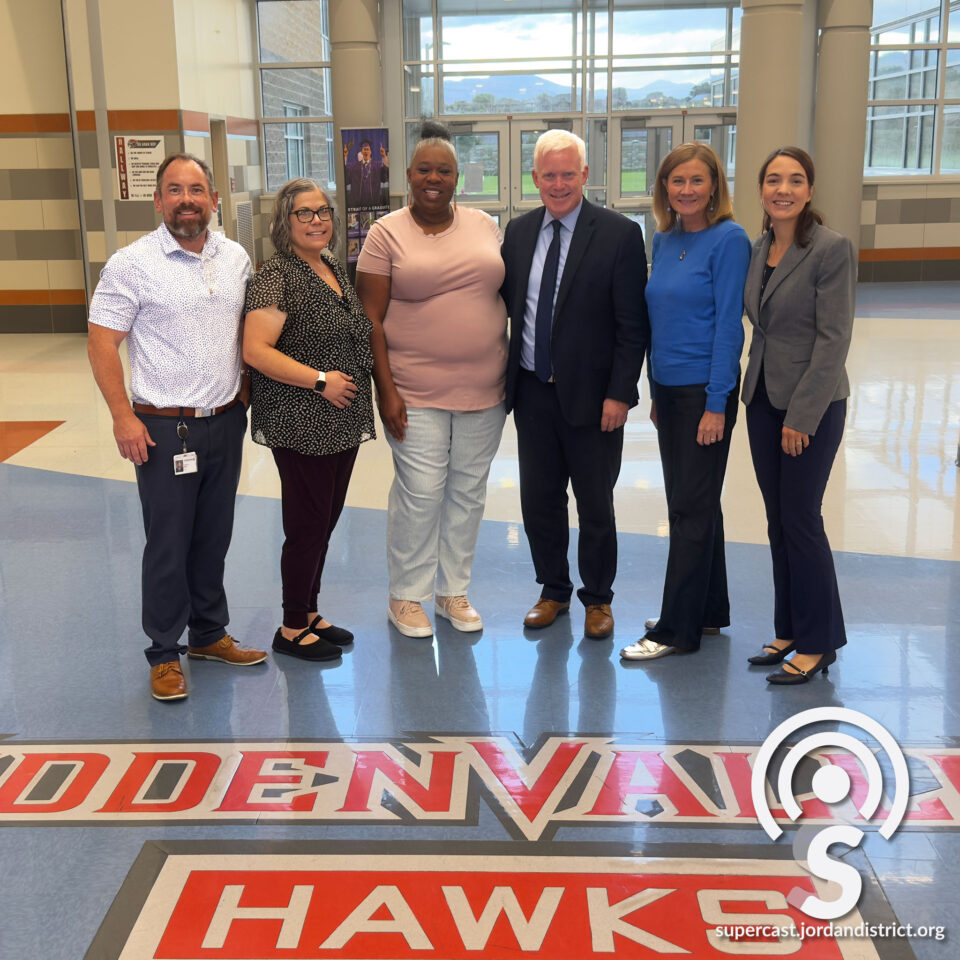
We're here at Hidden Valley Middle School talking with three members of the School Community Council. Introduce yourself, talk about your role on the Council, and your relationship to the school.
Julianne Best:
OK, I'm Julianne Best. I'm the Community Council Chair, or I was when we wrote this plan. I'm now a full-time math teacher here at the school, and I love Hidden Valley.
Bree Ervin:
I'm Bree Ervin. I am co-chair of the School Community Council here at Hidden Valley Middle School. I am also president-elect for our PTSA.
Sterling Hunt:
Sterling Hunt, principal at Hidden Valley Middle. And I was moved here just after winter break on January 2. And so I had the great privilege of really walking into a fantastic School Community Council team.
Anthony Godfrey:
And you've been highlighted at the state level just for the great work on your plan, focused on the highest academic need here at Hidden Valley. So tell us a little bit about what that entails and about your plan and what your focus is as a school with those Land Trust funds.
Julianne Best:
Well, I remember that when we were in that meeting, we wanted it to be very focused on what the kids needed, because we didn't want to be putting extra things where the money wasn't needed. And so for us, we needed a lot of growth with, especially, math and with some of our other subjects. I'm trying to remember what they were like.
Sterling Hunt:
Language arts could use some help in improving student outcomes. Our science team was really leading out building-wide. And we were happy with where they're at. So our goal there was just to continue to sustain that.
Anthony Godfrey:
So what are some of the things that you focused on to help boost those math and language arts scores?
Bree Ervin:
Really want to focus on helping our teachers. Our teachers, if they have more assistance, more time, more peer-to-peer collaboration, then they can better perform to help our children. So we made sure that our teachers had academic coaches. We made sure that they had collaboration days. And over the summer, that they had PLC planning time as well.
Anthony Godfrey:
And what did that look like? You paid for part of that collaboration time over the summer using Land Trust?
Bree Ervin:
Yes, we paid for 15 hours of PLC planning and curriculum alignment over the summer. So whenever our teachers had time to get it done, they got it done instead of trying to squeeze it in during the school year and interrupt instruction time for our students.
Anthony Godfrey:
It really is different when you're able to take a pause over the summer and focus. And there's more work that happens over the summer than most people realize. And it's nice that the School Community Council recognized that and actually compensated teachers for time to be together. How did this feel as a parent to be part of this process and to be able to focus on academics and supporting teachers?
Bree Ervin:
It felt really good. I see what the plan has done. I see how that's playing out currently with my ninth grader and my seventh grader. So it is really nice to see that this is not just words on paper. It is action.
Anthony Godfrey:
You're already seeing an impact with your children.
Julianne Best:
Yeah, as a parent as well, I have to add to that. So my son was in seventh grade last year, and he's eighth grader this year. Elementary school, he was always getting ones on his RISE for math. It was really rough. And so now he's here. And the way that we're doing things, he's getting it. He's getting all threes now.
Anthony Godfrey:
Wow. I love that.
Julianne Best:
Showing a big difference.
Anthony Godfrey:
That's wonderful.
Bree Ervin:
We've got great teachers here as well. So that definitely helps out of our teaching staff here.
Anthony Godfrey:
You've been here, as you indicated, less than a year, but the end of one academic year and the start of another. Talk to me about the impact of this plan and this School Community Council.
Sterling Hunt:
It's exciting to work, to come in mid-year. It's exciting to meet really engaged parents that are working with us on our School Community Council and PTSA and our other programs in the building. It's exciting to work in a building that has fewer than 3,000 kids where I came from previously at Copper Hills. And so coming here, working with this particular team, these parents were very engaged. Many of them work in the building as subs. They come in when our teachers aren't here in the building. They know our students. They have students here. And so the goal is, as our team, is we know what our challenges are. Let's work together and provide the resources to our teachers and to the students in order to close these gaps.
Anthony Godfrey:
I love how intentional, just as you've described, the Council was about this is our need. What can we do very concretely to help this? And to already see impact is tremendous. Just to close out, tell me what you love most about Hidden Valley Middle School.
Julianne Best:
I love the students. I love the staff, but the kids, they're the center of it. They're wonderful. They're smart. They're funny. They're just amazing little human beings that are getting better every day and getting smarter every day.
Bree Ervin:
I love the community that we have here. My daughter did competitive cheer at a gym. So a lot of the boys and girls that were there go to school with her. So they know me. My son plays tackle football here in Riverton. And I see a lot of the boys that he's played. So I have a lot of extra children here. So it is just a lot of family-oriented love here. And that's what we're here for. We're here to love on these kids and take care of them and protect them, even though they may not like having homework. But that's what's necessary sometimes.
Anthony Godfrey:
Part of the package. Yes.
Sterling Hunt:
I just want to emphasize, we do have a fantastic community here. And there's something special coming down off the hill into this little bowl where Hidden Valley sits. And we know our students. We know our parents. And it's programs like the Land Trust that allows our parents to be involved, really intentionally involved, in what resources we're going to provide our teachers and students to improve student growth, student engagement, overall student success. And I've thoroughly enjoyed that, being here at Hidden Valley, just working with great parents and great faculty and staff members and awesome students with a common goal of, we only get them here for three years. They're going to be the best three years they're going to have.
Anthony Godfrey:
Fantastic. It's a wonderful community, an incredible school. And it's a pleasure talking with all of you today. Thank you for everything you're doing to make this such a great place to be.
All:
Thank you. Thank you. Thank you.
Anthony Godfrey:
Thanks for joining us on another episode of the Supercast. Remember, “Education is the most important thing you will do today!” We'll see you out there.