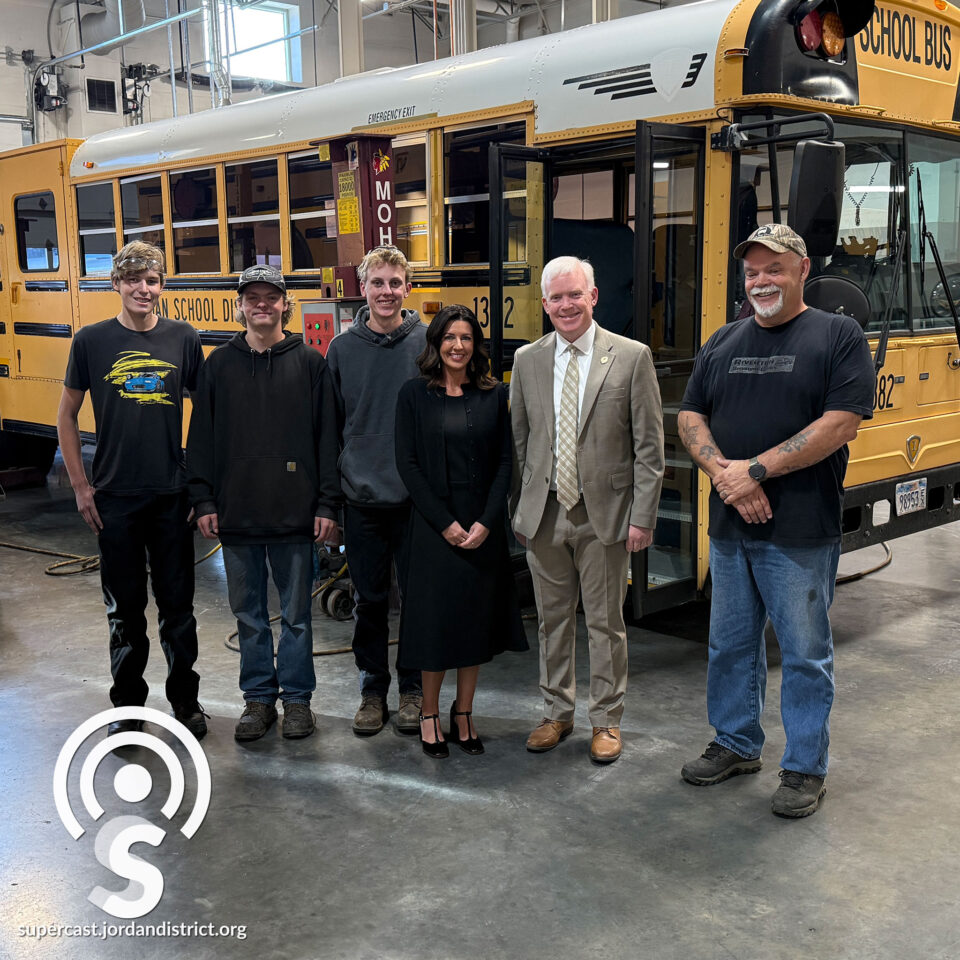
They are getting top notch on-the-job training by industry professionals while still in high school.
On this episode of the Supercast, hear from some high school students themselves about all the benefits of internships offered in Career and Technical Education or CTE. Find out how internships allow juniors and seniors to have fun doing what they love, while exploring career paths, building professional networks, gaining industry-recognized skills, and earning high school credit.
Audio Transcription
Teacher:
They're working in an area that they're interested in pursuing once they graduate from high school.
Student:
I've always been passionate on working things, but you know mostly cars and smaller pickup trucks, so working on a bus, it's a whole other story.
Student:
I love the relationships that we have with everyone here. It feels like you actually work here.
Anthony Godfrey:
Hello and welcome to the Supercast. I'm your host, Superintendent Anthony Godfrey. They are getting top-notch on-the-job training from industry professionals while still in high school. On this episode of the Supercast, hear from some high school students themselves about the many benefits of internships offered in Career and Technical Education, or CTE. Find out how internships allow juniors and seniors to have fun doing what they love while exploring career paths, building professional networks, gaining industry-recognized skills, and earning high school credit.
Anthony Godfrey:
We are here at the Transportation Department talking with Melissa about the internship that students are participating in here as mechanics in the Transportation Department. Melissa, introduce yourself and tell us a little bit about this program and how it works.
Teacher:
Sure. So my name is Melissa Goble. I'm the CTE internship teacher for Jordan School District. This program is …. the students apply for it. They interview. We place interns in all CTE pathways. This just happens to be one of them. Once they're in the program, they have to get a minimum of 40 hours of internship time, and then they also complete a LinkedIn profile. We work on some employability skills, things like that. We just help mentor them through the semester.
Anthony Godfrey:
A lot of the internships are created with outside companies and other groups, but we get to benefit from these students and what they're learning right here in the Transportation Department. That's what's unique about this one.
Teacher:
Yes. It's great. We are very excited that our own district took on students. We're hoping that it will spread the excitement because it is beneficial. The kids get to be invested in their district. They're getting to learn new things, and they're with our own people.
Anthony Godfrey:
Now, you started recently in your role in the last year or two, and I have seen a real uptick in just presence on LinkedIn, and internships have really been propelled since you started, and we've added this emphasis on internships. Just talk generally about what would attract a student to an internship and the kinds of internships that we have available in the District.
Teacher:
What attracts them, generally what I find, attracts them to the internship is the opportunity to work with industry. They're working in an area that they're interested in pursuing once they graduate from high school. They're meeting people who could give them recommendations, mentor them, help point them in the right direction. Sometimes they know what they want to do, but they don't know how to get there. I also have students who come to my program because they think they know, and then they find out that they want to go a little bit different direction, which is also a great way to get through my program.
Anthony Godfrey:
It's the perfect time to find out that this is not the career for you. A lot of times people love what they try, but if you don't, this is the time to find out, and that's long been something I knew was a benefit of CTE programs.
Teacher:
Absolutely. And they also, when they're working in industry, they find out that there's pathways they didn't even know about that are related to what they're interested in. It's just this might be a little bit more interesting, or it might be a little bit more accessible for them. And so that is awesome as well. And then we have, we do have a lot of internships. In fact, I have joked that I'm getting to the point where we have more internships than I have students right now. I need to switch my focus a little and really start targeting them because we've had so many great industry partners step up and offer us multiple opportunities. And from anything from our diesel students, we've got students who are doing aviation internships, engineering, business, all over. We're all over the place.
Anthony Godfrey:
So if someone with a business is listening and they think, "I'd love to have a couple of interns and I think I'm aligned with the CTE pathway," do they just reach out to you? We can put your email address in the show notes, and then you can get them set up with some great students.
Teacher:
Yeah, yeah, that would be great. I also can help them get into the schools a little bit before they take interns. If they want to do some job shadows or maybe a tour or something like that, I'm absolutely the person that can help them.
Anthony Godfrey:
Fantastic. Is a job shadow kind of a precursor to an internship sometimes?
Teacher:
Yeah, so we do have some programs that, well, in fact, Diesel, they go in their first semester, they spend time doing job shadows, so they'll spend just a few hours at different locations and they get to see different types of industry that's within their field. And then we go for the internships second semester.
Anthony Godfrey:
Wonderful. Well, thank you very much for everything you're doing to provide these opportunities for students and for businesses to benefit from these great students We talked about what businesses can do. If a parent or student's listening and they would like to be part of an internship next year, how do they go about doing that?
Teacher:
Well, there's a couple of ways that they can do that. First, the JordanTech.org is our website and our applications open every year in February, March timeframe. They can apply that way or my application actually stays open all year and they can go out to JordanTech.org again, but go to the CTE internship webpage and I have information there that they can apply. So it involves doing a resume and letting me know what they're interested in. And then I also should mention that one of the requirements for applying to my program is that they do have to have some coursework in their background.
Anthony Godfrey:
Okay. Wonderful. Richard, let's talk about Diesel Mechanics specifically and these students. Introduce yourself and tell us the history of internships in the Diesel Mechanics program in Transportation.
Richard Burrell:
My name is Richard Burrell. I'm the shop coordinator, shop foreman for Jordan School District here. I have 15 employees out here in the shop with me. We keep tabs on about 500, 600 vehicles.
Anthony Godfrey:
Yeah. Wow.
Richard Burrell:
So we're a full-time job.
Anthony Godfrey:
Millions of miles.
Richard Burrell:
Every day. So, and the internship, when I first started back in 1989, internship, we'd take on the interns from the schools like we did here, the colleges. And we would bring a couple of kids in and they'd work with us and the object of the game is to give them every chance what we do out here every day. I mean, oil changes, we do that a lot, but we do brake jobs, we do engine work, we do everything out here. So these kids, three kids right here, get in the middle of it all. I put them with each mechanic out there. It takes on a kid. It's a supervisor position. So they watch him and they teach him everything that goes on out here and what we have to do. Some days it's repeatedly learning how to do services, but they get into other things too, brake jobs and everything else and go with it. It takes a lot to keep these things on the road every day.
Anthony Godfrey:
Yes, it does. And we're glad to have their help. Tell me about these three students.
Richard Burrell:
These are great kids. They came in during their spring break time to work with us because we worked here. So they wanted to come in and keep playing. So we let them come in and work with us.
Anthony Godfrey:
That's awesome.
Richard Burrell:
And they enjoy what they're doing out here. And they're seven o'clock in the morning, they're here and they're here till ten o'clock every or twice a week. And they love what they do.
Anthony Godfrey:
I didn't know I was showing up so late into their shift here.
Richard Burrell:
I told them they had to stay somewhat clean today.
Anthony Godfrey:
All right. Well, all bets are off after we're done. You can get nice and dirty. Well, thank you for everything that you're teaching these students and the opportunities you're providing for them.
Richard Burrell:
We love these kids. They're good. Hopefully it can work out. When some of us retire, we can move other kids into this place.
Anthony Godfrey:
Well, you started just after Reagan was no longer president. So I mean, hopefully we have you for a few more years.
Richard Burrell:
Not too many more. But there's a few.
Anthony Godfrey:
All right. We'll get you for as long as we can have you, Richard. Stay with us when we come back. Hear from student interns in our own Transportation Department and find out what they are up to as diesel mechanics working on our school buses.
Male Voice:
Never miss an episode of the Supercast by liking and subscribing on your favorite podcasting platform. Find transcripts for this episode and others at supercast.jordandistrict.org.
Female Voice:
Does your student want to become a veterinarian, commercial pilot, programmer? Maybe they want to make a difference as a dental assistant. These are just some of the programs offered as part of career and technical education. CTE in Jordan School District. CTE provides the technical skills needed to prepare students for future employment or for a successful transition to post-secondary education. Career and Technical Education provides work-based learning opportunities. We partner with industry experts to offer apprenticeships and internships with students working in the real world at real jobs while going to school. The CTE experience starts in our elementary schools with the Kids' Marketplace and grows through middle and high school. To explore all CTE has to offer in Jordan School District, visit cte.jordandistrict.org today and let's get your child started on the pathway to a profession.
Anthony Godfrey:
All right, Richard. We're walking through the facility here and this is just a few years old. Talk to me about this facility.
Richard Burrell:
This is a four-year-old shop. We had it, the District, finally had it built four years ago. It's the best one in the state. Everybody's dreaming on it.
Anthony Godfrey:
Good. I like hearing that.
Richard Burrell:
Fourteen days. I have enough for everybody to do their work on here. These morning guys right here, these are the guys that do all the heavy stuff for me. These are the ones the kids work with. I split them up with each mechanic out here. Carl right here is doing suspension work on this thing. He's been noisy for the last two days out here. We're doing engine work. We do all sorts of stuff here. These guys stay busy and these kids like to learn. I split them up differently every day. So if he does suspension one day, he'll do something else the next day.
Anthony Godfrey:
Oh yeah, so they get the variety.
Richard Burrell:
They’ve got to get in there and learn. Yep.
Anthony Godfrey:
Yep, great.
Male Voice:
Chase that wire. And he started from the battery. It's right here at the battery that he's...
Anthony Godfrey:
We're talking now with three students here who are part of the Diesel Mechanics internship program in Transportation. Tell me your name, your grade, what school you're from, and then we'll talk a little bit about this program.
Student:
My name is Fred Bond. I'm a senior at Bingham High School.
Student:
Maverick Brown, also a senior at Bingham.
Student:
I'm Garrett Lewis and I go to Mountain Ridge. I'm a senior.
Anthony Godfrey:
Tell me what drew you to this program. What got you interested in Diesel Mechanics?
Student:
I've just been working on cars in my driveway for years. My dad works with FedEx and so I've just always been around semi-trucks and heavy-duty diesel. And so when I eventually got to the point where I was kind of looking for a career to go into, I decided that just being a mechanic was where I wanted to go, and I kind of went towards diesel because, like I said, I've been around them a long time. And so I got the opportunity to come here, and I just love doing it.
Anthony Godfrey:
Your experience here has made you more interested in becoming a diesel mechanic.
Student:
Absolutely.
Anthony Godfrey:
What is it about the experience that you've liked the most?
Student:
Just the way they work. It's kind of they give you time to do everything the right way. You're not rushed. You're able to do everything 100 percent, get it back on the road the way it came from the factory.
Anthony Godfrey:
Fantastic. What do you love most about this program?
Student:
I like the real-world experience, like actually working in a workplace environment. It's more professional, and it looked at on resume, and we get to actually work on things.
Anthony Godfrey:
Is the work harder or easier than you thought?
Student:
It's heavier.
Anthony Godfrey:
Describe that.
Student:
Well, everything's heavy. Just like him, I've always been passionate on working things, but mostly cars and smaller pickup trucks. So working on a bus, it's a whole other story. Everything's tripled the weight and size.
Anthony Godfrey:
Have you been able to convert a school bus into a transformer yet?
Student:
Not yet, no. Still working on it.
Anthony Godfrey:
That's toward the end of the semester. What drew you to diesel mechanics initially?
Student:
Just the passion for working on things and then of course the workplace experience.
Anthony Godfrey:
Okay, great. Tell me about your experience here.
Student:
My experience has been great. I initially wanted to go into the program. I liked the CTE stuff and the hands-on stuff. I like learning with my hands and doing things more. I began employment just like changing oil. So I had a little bit of experience working on cars. Then this opportunity presented itself, and I decided to take it. Then I had the internship, and this has been really great for getting real-world experience compared to just like in the classroom where it's not quite the same, but working on these school buses has been really great.
Anthony Godfrey:
Does this make you more interested in a career in diesel mechanics? Or is this just something you do with your hands that's going to help you along another path?
Student:
It's made me more interested. It's definitely taught me a lot of things. Some good things, some bad things about the industry. What direction in the industry I want to go. It's been really great to learn the ins and outs of what it's like working.
Anthony Godfrey:
Has it opened up some other directions that you might choose by being here?
Student:
Somewhat. Personally, I'd like to go into diesel, but then maybe go into a little bit more management, business-related stuff. That's just me personally, but I really enjoy working on these trucks and machines and stuff.
Anthony Godfrey:
Having the hands-on experience can really set you on that path and give you some experience that allows you to be effective as a manager.
Student:
Oh yeah, for sure. I've seen my employment translate over to my good classroom and this internship.
Anthony Godfrey:
Right. I'm glad that you've seen a relationship between the two. How about you? What are you thinking career-wise?
Student:
Well, at first I want to work on heavy duty machinery, and then later on I want to start my own performance shop.
Anthony Godfrey:
Oh, nice. That's great. Tell me about something that you've learned in your experience here. Either mechanical, technical, or just about being at the workplace generally.
Student:
When school buses come into you, sometimes it's diagnosing issues. It isn't as easy as it always seems. Sometimes it's a way longer process than you initially think it will be. It's just the range of different things that you see here. It's not just five different failures that happen all the time. You get so many different things on these buses that you have to go through.
Anthony Godfrey:
But the problem-solving aspect of it must be pretty satisfying when you do figure out what's wrong.
Student:
Oh, absolutely.
Anthony Godfrey:
Yeah, that's awesome. How about for you?
Student:
All the tools. There are so many tools. There's a tool for every job. Having the right tool will make everything easier. For the tires, getting those tires off by themselves would be crazy hard. But they've got that tool for it so it makes it way easier.
Anthony Godfrey:
So the right tool for the right job and you’re way ahead.
Student:
Yeah, for sure.
Anthony Godfrey:
There's a life lesson in that. And for you?
Student:
For me, it's just doing the job right and making sure you have a high-quality of work. One of these guys out here really takes pride in doing it correct the first time. All the guys take pride in doing it correct the first time. They don't want to have buses coming back with problems that they quote “fixed.” They cut corners. So it's been really great to learn how to do the job right and learn to always do the job right so that you don't have problems.
Anthony Godfrey:
Pride in your work. Again, something that will translate to whatever you end up doing.
Student:
Oh yeah, definitely.
Anthony Godfrey:
Tell me about Richard and the group. What's it like working with the crew?
Student:
It's super chill. I show up and we kind of sit down for a second. Richard gets us all situated and then he's like, "All right. I'll put you with this guy today. I'll put you with that guy today." No. And then we just kind of follow the guys around and they're like, "All right. Here's what we're doing. Here, pass me this. Take this bolt off. Take this thing off." And then some guys teach more than others, but it's always a good learning experience.
Student:
Oh, it's great. Everybody's positive for the most part and it's always a good time to joke around with people in the real world experience and actually get to work on things and practice taking stuff apart and put it back together in the correct way.
Anthony Godfrey:
Excellent.
Student:
I love the environment here with the people. I love the relationships that we have with everyone here. It feels like you actually work here. It's not scary to go up to them. We've been getting to know all the people here. It's not intimidating or anything like that. You just get to talk to them like they're your buddies.
Anthony Godfrey:
Fantastic. I love that. So, well, we're very lucky to have you here and thanks for taking time to talk with me today. I know you’ve got work to do.
Anthony Godfrey:
Thanks for joining us on another episode of the Supercast. Remember, “Education is the most important thing you'll do today!” We'll see you out there.