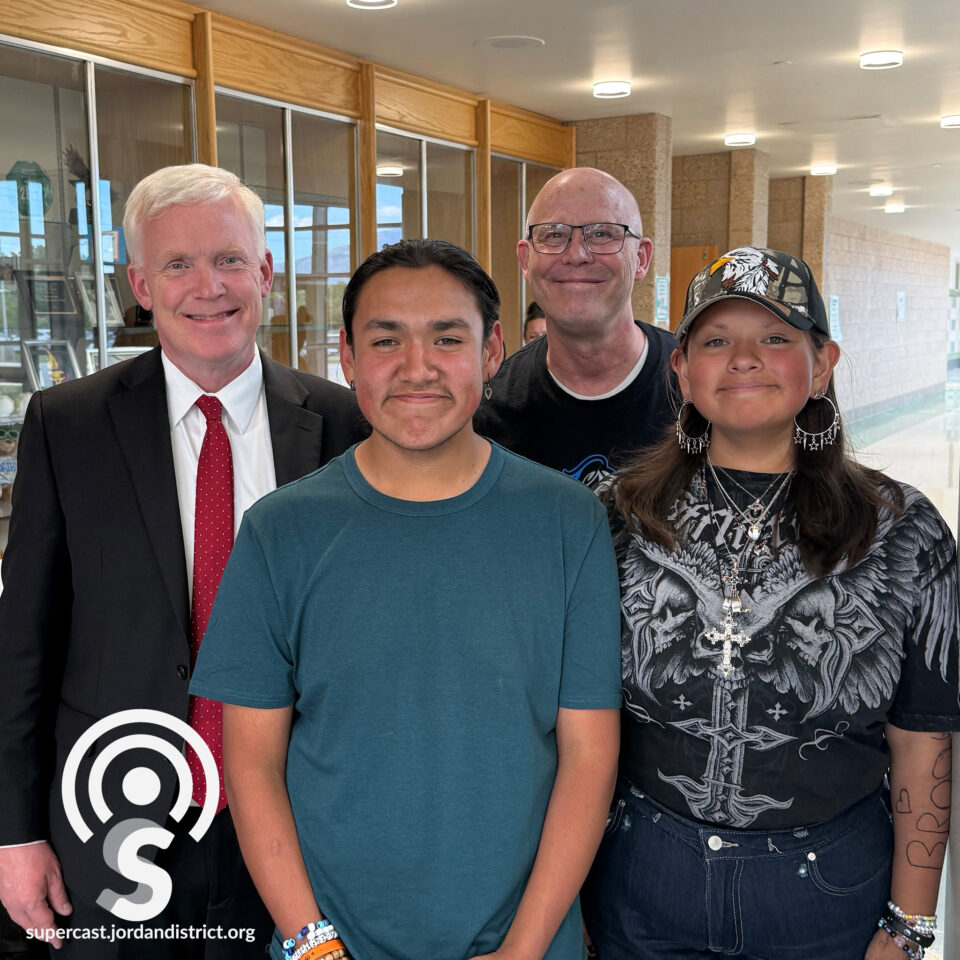
They have dedicated their lives to celebrating culture, community, and academic achievement and now they’ve made it to graduation, getting well-earned high school diplomas.
On this episode of the Supercast, meet some multi-talented Native American students who were part of an annual Jordan School District Community Night celebrating culture through traditional dance, music, a dynamic drum circle, art, and more. Hear how the Native American students hope to use their academic success to serve as a springboard for future pursuits and personal growth.
Audio Transcription
Student:
What it means to us is it just brings us a lot of joy. It means of being part of something, being together with people of any race, whether you're Native American, Mexican, but it's just bringing together togetherness and just seeing the different diversities that you see or ethnicities. It's just really cool.
Anthony Godfrey:
Hello and welcome to the Supercast. I'm your host, Superintendent Anthony Godfrey. They have dedicated their lives to celebrating culture, community, and academic achievement, and now they've made it to graduation, receiving well-earned high school diplomas. On this episode of the Supercast, meet some multi-talented Native American students who were part of an annual Jordan School District Community Night, celebrating culture through traditional dance, music, a dynamic drum circle, art, and more. Hear how the Native American students hope to use their academic success to serve as a springboard for future pursuits and personal growth.
Anthony Godfrey:
We're here at West Jordan Middle School talking with two of our students who are part of the Native American program tonight. Introduce yourselves and tell us a little bit about what this night is all about.
DJ:
Hello, I am DJ. I am part of the West Jordan High School Affinity Club, and I am here selling beadwork. We came here to present some of the beads that we have presented that our students or some of the people in our club have made. So all these beads or everything you see on the table that we have behind us has been made by our hands. We also came here to present to see other and just can't wait to see like the diversity we see here in different tribes.
EJ Jones:
Hi, I'm EJ Jones. I'm one of the members of the West Jordan Affinity Club, and yes, we are selling bracelets that are made by our wonderful students. Not only do we not just have bracelets, we also have earrings and phone chains for by wonderful students of ours that joined our club, and I'm so glad to see so many people here tonight because it's like a wonderful experience.
Anthony Godfrey:
What does it mean to you both to be part of the Native American Affinity Group at your school?
Student:
It brings us, what it means to us is it just brings us a lot of joy. It means of being part of something, being together with people of any race, being whether you're Native American, Mexican, but it's just bringing together togetherness and just seeing the different diversities that you see or ethnicities. It's just really cool and being part of that club really immerses you into a whole new world where you've never seen. You see like these different creative backgrounds between different people, different stories, and it's just wonderful to see that.
Student:
Yeah, it's just honestly, this club to us honestly just shows us what, that you don't have to be a Native American to join it. You can just join it to show, we can like show you what us Native Americans do and you can show us what you do just so we all can connect as one person.
Anthony Godfrey:
As you mentioned, anyone can be a part of the group and really it's about connecting with each other and feeling a part of the broader school.
Students:
Yeah, exactly.
Anthony Godfrey:
Tell me about some of the experiences you've had through the Native American program. I know that there was a drum making class recently. What are some of the things that have happened as a result of the program and place here in Jordan?
Student:
So of course the drum making class, I can't put a finger on exactly a lot of the events, but I know like we've gone on a field trip sometimes to see like different like, I think it was the Natural History Museum. That was pretty fun and it's just it, and this program just brings you to like, it brings you to a whole new world.
Anthony Godfrey:
You mentioned the diversity of tribes here tonight. Do you know which tribes are represented?
Student:
Navajo is definitely a big one. I know that maybe Ute, probably Apache, Shoshone, and just like there's so many to name that I just can't keep, but there's probably quite a bit that are here tonight that are being represented and some that are wanting to shine out more.
Anthony Godfrey:
I think that's really exciting that so many tribes are represented and I love this program in the way that graduates are honored with a sash and just with a recognition for all of your accomplishments. How does it feel to be at this stage? You know, if this, if this represents your, your education, you're right here, you're right at the last few weeks as a senior, how does it feel to be honored tonight?
Student:
It feels very like, like it feels very like surreal. It just feels like it's like it just all went by so quick and it's just like being here is like, you're actually like, “oh my gosh, it's like happening.” Like it's, it just immerses you into a whole new world and you're just like, “oh my gosh, what's like, it's happening now.” It's like, you just like, it like, “where did the time go? Where did the things go?” It just flew by so quick.
Anthony Godfrey:
So, well it only goes by faster and faster. What's next for you?
Student:
Straight to college. I'm going to community college first to get my general education done.
Anthony Godfrey:
Do you know what you want to study beyond that?
Student:
I know I want to study computer science and then hopefully become a teacher.
Anthony Godfrey:
Wonderful.
Student:
Yeah.
Anthony Godfrey:
Well, we'll watch for you coming back to Jordan School District.
Student:
Okay then.
Anthony Godfrey:
All right, thanks very much for talking with us.
Student:
Thank you so much.
Anthony Godfrey:
Stay with us when we come back. More with the Jordan School District Community Night celebrating our Native American students.
Male Voice:
Never miss an episode of The Supercast by liking and subscribing on your favorite podcasting platform. Find transcripts for this episode and others at supercast.jordandistrict.org.
Female Voice:
Does your child need the flexibility to learn from anywhere at any time, on a cruise, in another country, or simply at home cozy on the couch? The Jordan Virtual Learning Academy is tailor-made for you and your family. It's personalized, dynamic virtual learning on your schedule. The Jordan Virtual Learning Academy is an integrated system of three schools in Jordan School District, Rocky Peak Virtual Elementary School, Kelsey Peak Virtual Middle School, and Kings Peak High School. Our programs are designed to meet or exceed district and state core curriculum standards, ensuring your child receives a superior educational experience tailored to their needs. Join us today at JordanVirtual.org.
Anthony Godfrey:
Now we're going to come into the gym at West Jordan Middle School and watch some round dances with participants from across the District.
Brenda Villal :
Thank you so much for joining us today. I'd like to introduce myself in the traditional way that my people introduce themselves.
Brenda Villal :
I just said that my name is Brenda Villal and I am born into the Salt Clan, born for the Taurine House people, and my maternal grandparents are the Edgewater people, and that is how I identify as a woman, as a mother, and as a friend. Do I have any relatives here today? Is there any? There we go. Someone is Ashia or is it Kiaani? So, welcome. Thank you so much to Ami for allowing us to come and lead this round dance. The round dance is done all over the United States and Canada and beyond. It is a social dance that is done to show community and connection. And take a look at the circle. The circle shows that all are equal. This young girl here is equal to this tall man right over there with the tie. This young girl here is equal to this person over here in the blue suit. So a circle brings everyone together in an equal place or an equal space. The round dance is a social dance. Everyone is invited to participate. We always go in a clockwise direction and we usually hold hands and we love to have everyone participate if they would like to. If there are people that don't fit in the circle, just come grab somebody's hand and we'll make the circle bigger for you so that you all get to be a part of it.
Hello. My name is Brenda Villal and that's the way I identify. I am Dineh. I am born into the Salt Clan. I'm born for the Towering House people. Today or tonight we were able to experience the Native American round dance. The only dance that we have found that the eight sovereign nations within Utah, the only dance that can be done that where everyone is invited to participate. But it is important for these nations to have a Native American representative either host or lead. We write educational resources. We co-create with the eight sovereign nations to change the narrative about indigenous people here within Utah. And tonight we were able to share the Native American round dance. We were very fortunate to have a drum group by the name of Red Spirit join us here in this beautiful building for all of the children and parents and staff in Jordan School District to experience the round dance.
[Music]Anthony Godfrey:
We also have the Native American mentor here with us from Jordan School District Introduce yourself and tell us a little bit about this program and what it involves.
Steve Hawkins:
Sure. I'm Steve Hawkins and I'm the high school mentor in the District for Native American students. The big goal of the program is to help students pursue their educational and vocational goals in a culturally sensitive way to help them retain a sense of culture, be exposed to their own Native culture and strengthen that within the education system. One thing you should know is these kids are scary overachievers. You'd be very proud of them, Dr. Godfrey. They, the average GPA for our Native students is 3.0. Herriman High School students have a 3.5 GPA. The Native students there, two of them have 4.0.
Anthony Godfrey:
Oh that's awesome.
Steve Hawkins:
And also so many of the students are deeply involved in the JATC like DJ, who you just met, has learned computer programming at the JATC and 10 of our students have had a fantastic experience there and prepared for careers after high school.
Anthony Godfrey:
How many Native American students would you say do we have at any given high school?
Steve Hawkins:
West Jordan and Copper Hills have quite a few, about 30 each. Our lowest number is probably at Riverton with five. So, I'd say probably the average is 15 to 20.
Anthony Godfrey:
To me that just makes it so much more important for you to be there to connect and make sure that in schools of thousands of students that they connect with the broader community and don't lose the sense of personal identity, and in fact, enrich their sense of personal identity.
Steve Hawkins:
Yeah, and that's really the goal of the program particularly like you said is identifying with their culture and continuing to connect with that. That's why we did drum making which is not just making an instrument but there's a whole discussion on the spiritual and cultural relevance of it and it was a great experience. The kids were engaged from the very start to the very end.
Anthony Godfrey:
On a night like this, beyond what we do as a District and the work you do as a mentor, we see the support from families and from the broader community and the donations that come in and of the booths that are here. Describe a little bit of the family and community connection that's created.
Steve Hawkins:
One thing you'll see when you talk Native families is they are so close. Not only the parents are inspiring their kids pushing them to educate pushing them to get educated to achieve but they're also very tied in with their aunties and their grandparents and there's this wonderful sense of family values and community among the Native Americans here as witnessed by all the people who are here. The community itself has also been incredibly supportive. We have got thousands and thousands of dollars of prizes donated from retailers in the community in support of our Native students.
Anthony Godfrey:
It grows every year and it's really fun. I really look forward to it this time of year. What do you love most about being a mentor for our Native American students in high school?
Steve Hawkins:
Oh by far the best part is just to sit down and talk with them one-on-one and find out how life is going, how school is going and hear about their plans. These kids have great vision. It's really impressive that they are so capable of expressing themselves, that they have goals, they know what they want to do and they also know where they're there as they haven't decided yet, which of course who knows at 15 right?
Anthony Godfrey:
Sure, sure.
Steve Hawkins:
But they're just they're the kind of people that give you really hope for your country and your world just talking to them.
Anthony Godfrey:
I love that. That's what working with youth is all about. So well thank you for everything that you do and for talking with us tonight. We have a great night ahead of us.
Steve Hawkins:
It’s a pleasure. Thank you.
Anthony Godfrey:
Thanks for joining us on another episode of the Supercast. Remember, “Education is the most important thing you'll do today!” We'll see you out there.