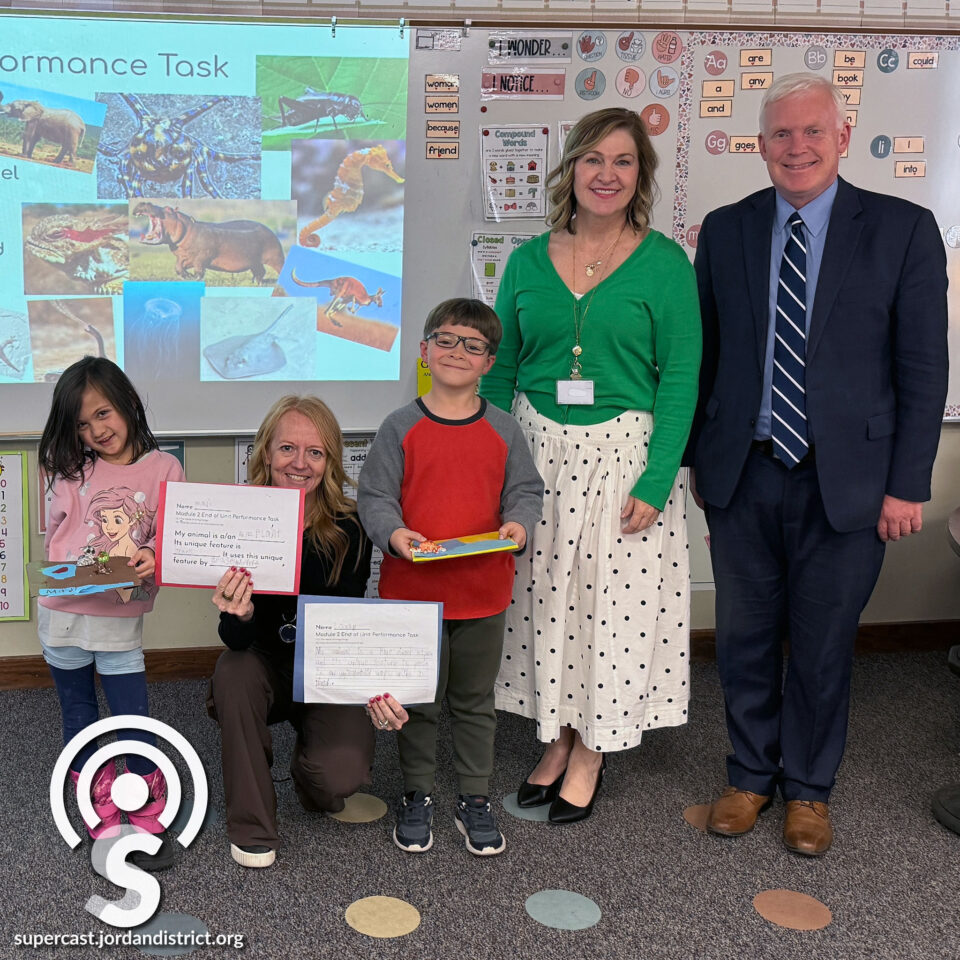
They are learning literacy by making clay model animals like a tiny toxic octopus and a very interesting elephant. It's all part of a Language Arts Curriculum called Wit and Wisdom that is fostering critical thinking in students across Jordan School District.
On this episode of the Supercast, we take you to Terra Linda Elementary School where a first-grade teaching team is taking student success to new heights with this rich Wit and Wisdom reading experience and they're inviting parents to be part of it all.
Audio Transcription
Michelle Lovell:
Terra Linda has risen to the top of the District for first grade data for middle of year.
Aubrey McDonald:
We always talk about in our class what do we want to do?
Students:
Cross our midline.
Aubrey McDonald:
And so when we do something with art and then write about it we're definitely crossing our midline.
Student:
It helps us remember.
Michelle Lovell:
You are being very intentional about your students’ reading needs and the progress they're making.
Anthony Godfrey:
Hello and welcome to the Supercast. I'm your host, Superintendent Anthony Godfrey. They are improving literacy by making clay model animals, like a tiny toxic octopus and a very interesting elephant. It's all in support of a language arts curriculum called “Wit and Wisdom” that is fostering critical thinking in students across Jordan School District. On this episode of the Supercast, we take you to Terra Linda Elementary School, where a team of first-grade teachers is finding unparalleled student success using this rich Wit and Wisdom reading experience, and they're inviting parents to be part of it all.
Anthony Godfrey:
We're here with Michelle Lovell and Aubrey McDonald talking about Wit and Wisdom and the way it's used in a first-grade classroom here at Terra Linda. Thanks for talking with us today.
Aubrey McDonald:
I'm happy to. Thanks for coming.
Anthony Godfrey:
Michelle, talk generally about Wit and Wisdom. We added that in the last couple of years in Jordan School District. What is it and what is it intended to accomplish? And then let's talk about how it's been adapted for use in this first grade classroom so effectively.
Michelle Lovell:
So Wit and Wisdom is a curriculum resource that we use in Jordan School District for language arts standards. This program is meant to be a knowledge-based knowledge-building program and it incorporates looking at reading text, it incorporates looking at art, talking and dialoguing about what they're learning, diving into text, finding text evidence, doing writing activities, and it does not have a phonics component. We still use UFLY for phonics, but the big pieces of Wit and Wisdom address those vocabulary, language, speaking, listening, and text-dependent kinds of pieces of the core.
Anthony Godfrey:
This is the rich reading experience that students get in conjunction with the phonics that they're learning.
Michelle Lovell:
Absolutely, and one of the pieces that we love about Wit and Wisdom is how deeply kids learn about topics because the reality is, if you aren't able, if you don't know a lot about a topic, you really can't speak to that topic, and if you can't speak to the topic, you can't write about it either. So being able to talk about something and have a deep knowledge base is a precursor to being able to write effectively about that topic. One of the things that I have really loved about Wit and Wisdom is going into classrooms and seeing the discussions kids have and I've just seen it in classroom after classroom with students talking about a book and bringing out parts of the book and having just amazing discussions about what they're reading, and because they have such strong discussions, that impacts what they can write about.
Anthony Godfrey:
The content knowledge is a really important companion to the just reading skills that we're teaching, so that they're getting this deeper knowledge, they're able to write about it, they're able to discuss it and there's some context for the reading that they're learning and there's some joy in reading these books and learning about the world around them.
Michelle Lovell:
Yes absolutely, and being able to also realize you can go back into a text you once you've read something and you want to talk about the details that we're giving kids the skills to be able to go back into a book, look for text evidence, cite textual evidence, which is — that's a skill that they're going to always need throughout their lives, and then relate those texts to other texts that they've read, relate them to other things that they're learning, art, science, social studies, all of those pieces coming together to build a huge knowledge base for kids.
Anthony Godfrey:
And to make a little twist on a common phrase, you're learning to read and learning while you read about all of these different topics, and as we visit this classroom today, we're going to learn about animals and what students learned about animals, which is really exciting for a first grader in particular.
Michelle Lovell:
Yes, and that's one of their science topics: learning about animal habitats and what animals do.
Anthony Godfrey:
So it's that overlap of getting a lot of things accomplished with the same with the same work that's being done in class.
Michelle Lovell:
That's correct.
Anthony Godfrey:
You've talked about fidelity versus integrity when using Wit and Wisdom in the classroom because this was a big lift. It was a big shift for students and for teachers from what we had been doing previously. So talk about the difference there.
Michelle Lovell:
So when we're talking about fidelity, we mean that we don't want to change any element of a curriculum, that it needs to be read verbatim and we're not going to change anything in the curriculum. Integrity means that we're going to have the outcome of the curriculum, and we're going to meet the learning goals and the objectives but teachers have a little more autonomy to make instructional decisions based upon their student needs. And so our goal with Wit and Wisdom is that teachers would read the analyze section of the lessons and read the learning goals and stay true to those, and as they're going through the lessons, to be able to make those teacher moves regarding how many questions they're asking and what types of questions, scaffolding background knowledge when it's needed, helping students who are reluctant learners to build that that knowledge base, and then even adding in and bringing in other topics as they, as what's happened in this classroom, where they're incorporating pieces that they're staying true to the Wit and Wisdom lessons and the integrity of the lessons, but they're building in and upon that, to bring in art and other pieces of science.
Anthony Godfrey:
Which brings us to Aubrey everything that she's doing with her first graders to make sure that this learning comes alive and is memorable and you've really got their brains firing on all pistons so talk about what you have done here in this classroom and what you did last Friday, your showcase.
Aubrey McDonald :
So for finishing module two, the end of module task is actually to write an informative paragraph about an animal, and we thought what could we do to mix that up a little bit, to add some art and to add a science standard in there as well. So last year my team and I we came up with having the students sculpt an animal. It had to include their unique feature and then we had them write what the animal was, what the unique feature was, and then what how the animal uses that unique feature because that's what the whole module was about is how can we learn from animals and their unique features. Last Friday we held a showcase and we invited students, all the students in the school they could come visit each of the three classrooms, and then we also invited some people from the community and the school district and then from 12:30 to about 12:55 we invited parents to come in and look at the projects. The students were so excited to share with their parents, and many of them have siblings in the school as well so you could just see the little first graders faces light up when big brother and sister came in and they had something exciting to share with them.
Anthony Godfrey:
Yeah and the pride in the learning that's taken place in the project that they have is really fun to see. Now they each wrote a paragraph about their about, their animal and they also sculpted the animal and put it in kind of a setting. So talk us through some of these projects that you have here on the table.
Aubrey McDonald :
Well one student decided, she did jellyfish and she actually made it a little jellyfish family.
Anthony Godfrey:
I would think it would be pretty hard to make a jellyfish out of clay but that's a very good representation. It's and, is the color did they color it with markers after work?
Aubrey McDonald :
Yes so we I had some markers and we did the coloring. Last year we had so this is our second year. Last year we put them on paper plates and they drew a little bit of a background and I thought well why don't we do some butcher paper this time and because the paper plate has the ridges and things so just to make it a little look a little bit nicer. So we just wrapped some cardboard in their color of what the setting for the environment, their habitat that they wanted it to be in.
Anthony Godfrey:
Yeah yeah, we test at various times to see the progress that students are making, and you showed me earlier today the progress that first grade students in Terra Linda are making. Talk to me about that, Michelle.
Michelle Lovell:
Yeah it was really exciting to see. We have midterm goals where we want the kids to meet learning goals in the middle of the year so they'll be on target to meet goals at the end of the year and Terra Linda has risen to the top of the District for first grade data.
Anthony Godfrey:
I want you to say that one more time.
Michelle Lovell:
Yeah, Terra Linda has risen to the top of the District for first grade data for middle of year and that was just really exciting to see. In talking with your administrator, you know she mentioned that you are being very intentional about your students’ reading needs and the progress they're making, and you're being very strategic about instruction and intervention. She also mentioned that you have coaches that work with you in the building and that you all — that it's really a community effort. She also mentioned that you bring in your parents and include your community in your students' learning, and this is a great example. Aubrey, how does it feel to know that you have shown such incredible growth, such great scores at the middle of the year.
Aubrey McDonald :
Well, we did it as a team. So, Mrs. Davis and Miss Carlson definitely shared. We shared all the success together.
Anthony Godfrey:
Stay with us when we come back find out what a tiny toxic octopus and interesting elephant have to do with Wit and Wisdom and student success in literacy.
Male Voice:
Never miss an episode of the Supercast by liking and subscribing on your favorite podcasting platform. Find transcripts for this episode and others at supercast.jordandistrict.org.
Female Voice:
In Jordan School District communicating and connecting with parents is really important and that's why we're very excited about ParentSquare. ParentSquare has replaced Skylert as the District's new communication platform. With ParentSquare, you'll receive all District and school communication via email, text and/or the app based on your preference. All messages can be translated to your preferred home language indicated in Skyward and it takes less than a minute to set up your notification preferences. You can use the ParentSquare app on any device. The app is available at parentsquare.com/sign-in. We look forward to connecting with you through ParentSquare.
Anthony Godfrey:
So at this end of module two, you wanted to do a performance task that was not just paper and pencil. Tell me about what got you here and why you chose this particular kind of project, and then we'll talk with Logan and Maddie about their projects.
Aubrey McDonald:
We actually started this project and we did it last year. We were thinking about a way to have the students show us what they knew that wasn't just a paper pencil test. So we thought, I thought why don't we have them sculpt something with clay. So we got this white modeling clay, and then the performance task is to after learning about many different animals and their unique features, they were to create a model of an animal and its unique feature, and then we had them write what animal it was, what the unique feature was, and then what they do with that unique feature.
Anthony Godfrey:
That is a lot to take in. I think it's really exciting, first of all, to tie literacy to learning about animals and to bring art into it and allow them to do some sculpting instead of just writing the answers. What sort of responses have you seen with from students when they're able to interact with the material and the information they've learned in this way? 13:51
Aubrey McDonald:
My students have really enjoyed it and it was nice because this year we invited the other students in the school to come look at the projects. The second graders last year remembered that they did this project, too. A lot of them were even able to tell us their animal and their unique feature. So having them interact with the clay and then write about it, I think helps them. It'll be something that they'll remember.
Anthony Godfrey:
Yeah.
Aubrey McDonald:
Maybe even for let's hope for all of elementary school but I know they definitely remembered for the next year too.
Anthony Godfrey:
It gets their brain firing in different ways. I love that they got to come back and see what the fresh batch of first graders did this year and reminisce about their own work when they were younger in first grade not the older second graders that they are now.
Aubrey McDonald:
I had put out all the books that go with this module when we had visitors and many of the students from that were in the class last year were excited to see the books again. Then these guys, my students currently, just love to read the books and we always talk about in our class what do we want to do?
Students:
Cross our midline.
Aubrey McDonald:
Cross our midline. Yeah and so when we do something with art and then we write about it we're definitely crossing our midline because when we cross our midline what does it help us?
Student:
It helps us remember.
Anthony Godfrey:
Crossing the midline is using your left or right brain?
Aubrey McDonald:
Yeah, using both sides of the brain.
Anthony Godfrey:
That's wonderful.
Aubrey McDonald:
Yeah.
Anthony Godfrey:
So Logan, tell me about your project. What animal did you sculpt and what did you write about your animal? What unique features does your animal have?
Logan:
My animal is a blue-ringed octopus and its unique feature is poison in unexpected ways with its teeth.
Anthony Godfrey:
Poison in unexpected ways with its teeth. Tell me about that.
Logan:
So it like bites you and you don't even know it's there but you can die.
Anthony Godfrey:
Really? Hopefully I will never meet a blue-ringed octopus.
Aubrey McDonald:
Stay away from them, yes. Do you remember if the octopus was big or small?
Logan:
Small.
Aubrey McDonald:
Small. Yeah it can fit in your hand.
Anthony Godfrey:
Oh really?
Aubrey McDonald:
Yeah.
Anthony Godfrey:
So this is a tiny toxic octopus. That's terrifying. Why did you choose such a scary animal?
Logan:
I have honestly no idea.
Anthony Godfrey:
You know I have no idea how you chose that one. Okay that's great. I see that you have not only sculpted this very cool orange blue-ringed octopus but you put him on — is this now this is paper, blue paper that represents the ocean?
Logan:
Yeah.
Anthony Godfrey:
And the yellow is that the beach? Is that the sand?
Logan:
Yeah.
Anthony Godfrey:
Wow that's very cool you've put him in a whole environment there. Does he have a name?
Logan:
No.
Anthony Godfrey:
No name? Do you want to think of one right now?
Logan:
No.
Aubrey McDonald:
Logan doesn't always like to be creative so I was really excited to see that he really got into making the octopus because Logan is more like, “get to work, get my work done, and don't really want to draw a picture” so he put so much detail into it.
Anthony Godfrey:
That is a lot of detail. It looks really good. For someone who may not love creativity all the time this is very creative. Now I'm just gonna do a little audit of your octopus okay, is that all right?
Logan:
Yeah.
Anthony Godfrey:
An audit means I'm going to check the details of your octopus. Here we go. One, two, three, four, five, six, seven, eight. Yep, eight legs. That's quite an authentic octopus you have there. Very cool, Logan. Is this your favorite animal?
Logan:
No.
Anthony Godfrey:
What is your favorite animal?
Logan:
A lion but we didn't learn about lions.
Anthony Godfrey:
You didn't learn about lions. One day you will probably learn about lions, or maybe you already have. Have you already read some things about lions or do you just like them?
Logan:
I like them.
Anthony Godfrey:
Can I look at your handwriting here? That is really impressive. “My animal is a blue-ringed octopus, and its unique feature is poison.” This is really, really well done, Logan. I'm super impressed. Nice job.
Aubrey McDonald:
Good job, Logan.
Logan:
Thank you.
Anthony Godfrey:
All right Maddie, let's talk about yours here. What animal did you choose and what is the unique feature of this animal?
Maddie:
My animal is an elephant. Its unique feature is its trunk. It uses its unique feature by squirting water.
Anthony Godfrey:
Squirting water. Wow and why did you choose an elephant? What do you like about elephants?
Maddie:
Because they like because they're my favorite and I like them and I have a stuffy at home.
Anthony Godfrey:
You have a stuffy that's an elephant? What's your stuffy's name?
Maddie:
Ellie.
Anthony Godfrey:
Ellie the Elephant. Perfect name. Aren't you excited that elephants were one of the animals in your book?
Maddie:
Yes.
Anthony Godfrey:
Because you got to choose your favorite animal. Now talk to me about your sculpture here. It looks really good.
Maddie:
So this is a baby elephant and I drawed a tree with apples and oranges on it and then I did water with apple squirt on it.
Anthony Godfrey:
Oh, I did wonder about that. So there's a lake cut out here it looks like. Is that kind of a lake? That water? And then I saw a big red splotch covered colored in the middle.
Maddie:
I actually mean that's ketchup.
Anthony Godfrey:
Oh, you actually mean that it's ketchup. Okay, so there's water and ketchup and a tree with apples and oranges and a baby elephant that squirts water. This is not what I expected to see today, Maddie. Oh and the sky. This is the sky, Maddie? Oh I like that. And you wrote your name in the sky.
Maddie:
Yes.
Anthony Godfrey:
Describe your elephant for those who are listening to this podcast.
Maddie:
I actually love the eyes, too, creepy.
Anthony Godfrey:
The eyes are pretty large. You think they're creepy?
Maddie:
Yeah. ‘Cuz it . . .
Anthony Godfrey:
Oh yeah, they are big. I guess you could say they're creepy. I do see the big ears on the elephant though and the big trunk and you colored it gray. Did you do that with a marker?
Maddie:
Yes.
Anthony Godfrey:
This is well, this is really cool. I really love this. It's really nice talking with both of you. I'm very impressed with your reading and your writing and your creativity in making these sculptures. I'm really excited to see how well you're doing here in first grade. Thank you for spending time with me after school today.
Maddie:
Thank you.
Logan:
Thank you.
Anthony Godfrey:
How did parents react when they came in and saw their students' work?
Aubrey McDonald:
We had a really big turnout of parents and the students were so excited. They read it to their parent and then their parents. They would take their parent around and say, “Oh, you have to look at my friend’s. Oh look at this other friend’s. So they were just dragging them across the classroom, showing them all the pieces that all of their friends' pieces and they were really excited. Parents really enjoyed being here. Sometimes there's not a lot of opportunities for parents to come in during the school day to see things and so we wanted — this was another reason why we really like this idea is it gave us a chance to invite parents into the classroom and showcase the learning instead of just sending home. ‘Oh here's the test where the paper pencil test where they took and they wrote an informative paragraph about an animal.’ This gave something for to include more people.
Anthony Godfrey:
I love that you pulled families in the way that you did and this is really exciting. It's a great implementation of the program. So many layers to this activity with literacy and art and science. Just really exciting to see this. Thank you so much for everything you're doing here.
Aubrey McDonald:
Thank you so much for visiting. It's great to have guys come and give some feedback or and see the things that we're doing.
Anthony Godfrey:
I love how you thank your team. That's really how this works is when a whole team of teachers works together intentionally, and I'm thrilled to get to see it. So thank you for this wonderful classroom that you have.
Aubrey McDonald:
Thank you so much and I wish that we could have all, a whole team could have been here to chat with you too because we have really come together as a team, and we're really working hard and focusing on that. Like you had said we wouldn't be successful if we didn't have each other.
Anthony Godfrey:
It's exciting. Thank you.
Aubrey McDonald :
Thank you.
Anthony Godfrey:
Thanks for joining us on another episode of the Supercast. Remember, “Education is the most important thing you'll do today!” We'll see you out there.